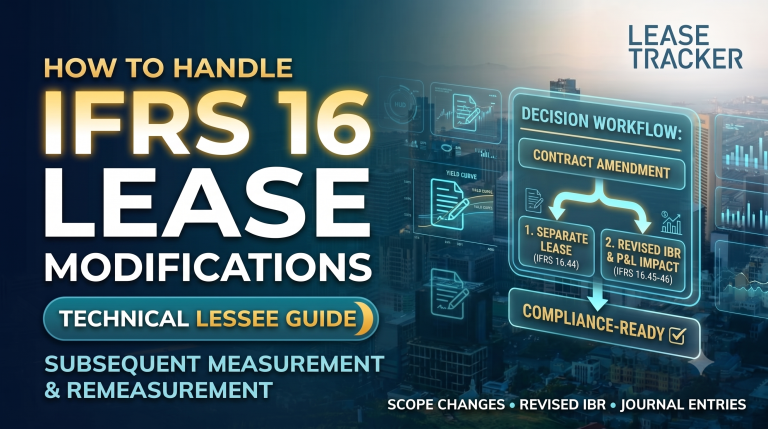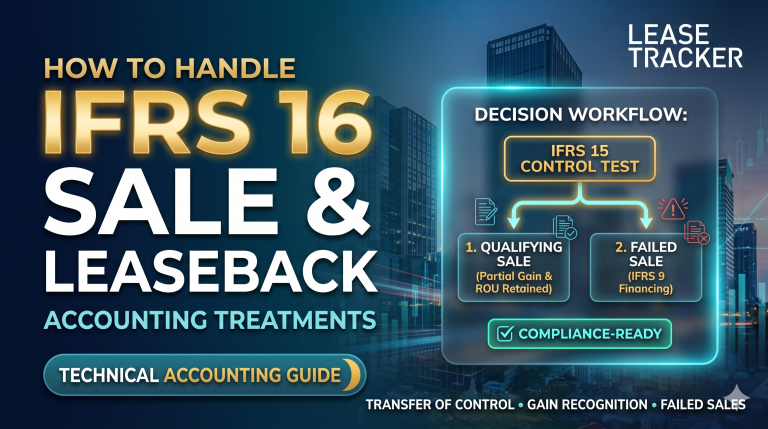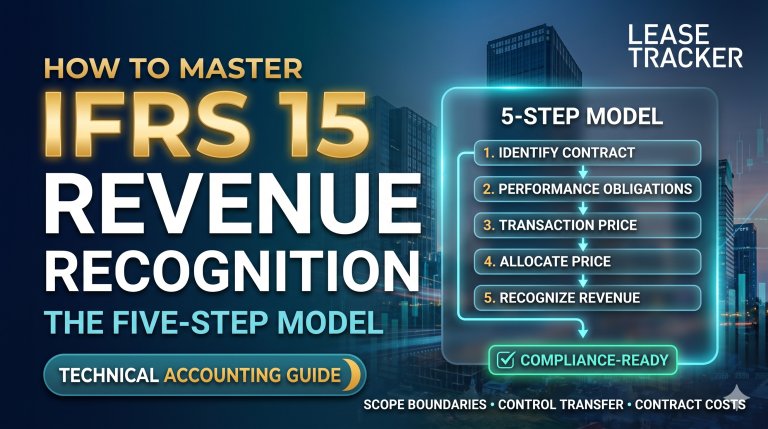
Navigating IFRS 16: Key Changes, Balance Sheet Impacts, and Real-World Implementation
1. The Sunset of IAS 17: Eliminating Off-Balance Sheet Financing
For decades, lease accounting under IAS 17 divided lease contracts into two mutually exclusive buckets: finance leases and operating leases. While finance leases were recognized on the balance sheet, operating leases were relegated to footnote disclosures, allowing lessees to account for rental commitments as simple off-balance sheet operating expenses recognized on a straight-line basis over the lease term.
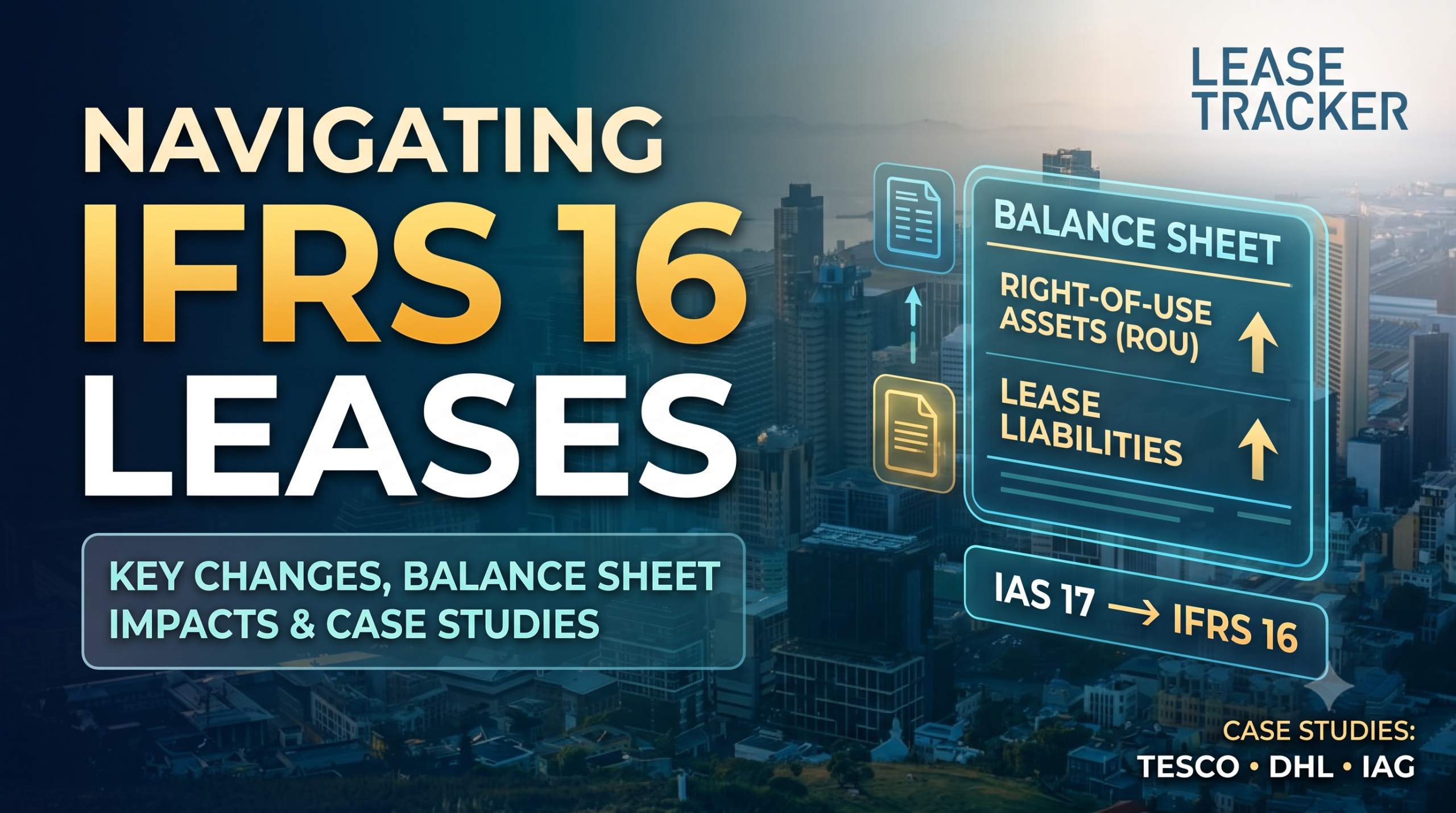
┌────────────────────────────────────────────────────────────────────────┐
│                   THE PRE- AND POST-IFRS 16 PARADIGM                   │
├──────────────────────────┬─────────────────────────────────────────────┤
│ IAS 17 (Legacy Model)    │ IFRS 16 (Current Standard)                  │
├──────────────────────────┼─────────────────────────────────────────────┤
│ Dual Lessee Model        │ Single Lessee Accounting Model              │
│ (Finance vs. Operating)  │ (All leases on-balance sheet)               │
├──────────────────────────┼─────────────────────────────────────────────┤
│ Operating Lease Rent:    │ Split Presentation:                         │
│ Single Operating Expense │ Depreciation (Operating) + Interest (Fin.)  │
├──────────────────────────┼─────────────────────────────────────────────┤
│ Off-Balance Sheet        │ Capitalized:                                │
│ Commitments in Notes     │ Right-of-Use Asset + Lease Liability        │
└──────────────────────────┴─────────────────────────────────────────────┘
This structural loophole drew substantial criticism from credit rating agencies, institutional investors, and global accounting standard-setters. Operating leases often concealed billions in committed future cash outflows, making capital structure comparisons distorted.
To restore transparency and comparability, the International Accounting Standards Board (IASB) issued IFRS 16 Leases, effective for annual reporting periods beginning on or after January 1, 2019. IFRS 16 superseded IAS 17, IFRIC 4 (Determining whether an Arrangement contains a Lease), SIC-15, and SIC-27. As set out in IFRS 16.51, the objective of the standard is to provide a transparent basis for users of financial statements to evaluate the true financial impact, financial position, and cash flows generated by lease contracts.
2. The Single Lessee Model: Recognition and Measurement Mechanics
IFRS 16 establishes a Single Lessee Accounting Model, eliminating the operating lease classification for entities acquiring the right to use an underlying asset.
┌─────────────────────────────────────────────────────────────────────────┐
│               IFRS 16 SINGLE LESSEE ACCOUNTING MODEL                    │
│                                                                         │
│   Initial Recognition at Commencement Date:                             │
│   ├── Dr: Right-of-Use (ROU) Asset                                      │
│   └── Cr: Lease Liability                                               │
│                                                                         │
│   Subsequent Measurement:                                               │
│   ├── ROU Asset   ───> Amortized straight-line (Operating Expense)      │
│   └── Liability   ───> Unwound via Effective Interest Rate (Fin. Cost)  │
└─────────────────────────────────────────────────────────────────────────┘
Initial Recognition at Commencement Date
Under IFRS 16, a lessee must recognize a Lease Liability and a corresponding Right-of-Use (ROU) Asset on its balance sheet at the commencement date of the contract:
- Lease Liability: Measured at the present value of the remaining lease payments that have not yet been paid at the commencement date.
- Right-of-Use (ROU) Asset: Represents the lessee’s legal right to control and direct the use of the identified asset over the agreed duration. The ROU asset initially equals the lease liability, adjusted for any lease payments made at or prior to the commencement date, initial direct costs incurred by the lessee, received lease incentives, and restoration or dismantling provisions required under IAS 37.
Subsequent Measurement
Following initial capitalization, the two sides of the entry diverge in their accounting treatment:
- The ROU Asset is depreciated similarly to property, plant, and equipment (PPE) under IAS 16, typically using a straight-line method over the shorter of the lease term or the underlying asset’s economic useful life.
- The Lease Liability is tracked using the effective interest method: it is reduced by lease payments made and accreted by interest expense calculated using the discount rate.
- As a result, the single operating lease rental charge under IAS 17 is replaced by an operating depreciation charge and a financing interest expense.
3. Scope Exclusions and Recognition Exemptions
While the scope of IFRS 16 covers nearly all contracts that convey the right to use an asset for a period of time in exchange for consideration, specific transactions remain outside its remit.
Scope Exclusions
The following asset categories are excluded from IFRS 16 and remain governed by other dedicated standards:
- Intellectual property licenses granted by a lessor (governed by IFRS 15).
- Rights held by lessees under licensing agreements for motion pictures, video recordings, plays, manuscripts, patents, and copyrights within the scope of IAS 38.
- Biological assets within the scope of IAS 41 held by a lessee.
- Service concession arrangements falling under IFRIC 12.
- Leases to explore for or exploit minerals, oil, natural gas, and similar non-regenerative natural resources.
Practical Recognition Exemptions (IFRS 16.5)
To minimize the administrative burden for high-volume, low-materiality transactions, IFRS 16 provides lessees with two explicit recognition exemptions:
- Short-Term Leases: Leases with a term of 12 months or less at the commencement date that do not include a purchase option.
- Low-Value Asset Leases: Assets that have an absolute value of approximately $5,000 or less when new (e.g., personal computers, office telephones, tablets, and small office furniture).
- When utilizing these exemptions, lessees recognize lease payments as an operating expense on a straight-line basis over the contract duration, keeping them off the balance sheet.
4. Technical Estimates: Lease Terms and Discount Rates
The valuation of both the ROU asset and lease liability hinges on two critical accounting judgments: determining the enforceable lease term and establishing the discount rate.
               DETERMINING THE IFRS 16 DISCOUNT RATE
               ═════════════════════════════════════
             Is the Interest Rate Implicit in the Lease
                       readily determinable?
                                │
                 ┌──────────────┴──────────────┐
                YES                            NO
                 │                             │
                 ▼                             ▼
       Apply Implicit Rate           Apply Incremental
     (Rare in third-party leases)  Borrowing Rate (IBR)
4.1. Assessing the Lease Term (IFRS 16.18)
The lease term is defined as the non-cancellable period of the contract, adjusted for:
- Periods covered by an option to extend the lease, provided the lessee is reasonably certain to exercise that option.
- Periods covered by an option to terminate the lease, provided the lessee is reasonably certain not to exercise that option.
A lessee must reassess the lease term upon the occurrence of a significant event or a material change in circumstances within its control that alters whether it remains reasonably certain to exercise or not exercise an option.
4.2. Determining the Incremental Borrowing Rate (IBR)
Under IFRS 16.26, lease payments must be discounted using the interest rate implicit in the lease. If that rate cannot be readily determined—which is typical for property and retail leases—the lessee must determine its Incremental Borrowing Rate (IBR).
IFRS 16 Definition: The IBR is the rate of interest that a lessee would have to pay to borrow over a similar term, and with a similar security, the funds necessary to obtain an asset of a similar value to the right-of-use asset in a similar economic environment.
Determining an IBR requires financial engineering, typically following a three-tier framework:
- Reference Rate: Establishing a baseline interest rate swap or government bond yield curve matching the contract currency and term.
- Financing Spread Adjustment: Adding an entity-specific credit spread reflecting the lessee’s credit rating and leverage profile.
- Lease-Specific Adjustments: Refining the rate for the nature of the underlying asset, security/collateralization terms, and payment profile.
5. Financial Statement & KPI Impacts: The “Front-Loading” Effect
By shifting operating leases onto the balance sheet and separating the expense line, IFRS 16 fundamentally alters corporate financial statements and executive KPIs.
| Financial Statement | Metric / Item | Impact Direction | Underlying Accounting Driver |
| Balance Sheet | Total Assets | Substantial Increase | Capitalization of newly recognized ROU Assets. |
| Total Debt / Liabilities | Substantial Increase | Inclusion of current and non-current Lease Liabilities. | |
| Gearing / Leverage Ratios | Worsens (Increases) | Debt increases significantly without a proportional increase in equity. | |
| Current Ratio | Declines | Short-term lease liabilities increase current liabilities. | |
| Income Statement | EBITDA & Operating Profit | Substantial Increase | Operating rental expense removed from operating expenditure. |
| Finance Costs | Increases | Interest expense recognized separately on lease liabilities. | |
| Net Income (Early Years) | Decreases (Dilutive) | Sum of straight-line depreciation and interest exceeds old rent. | |
| Cash Flow Statement | Operating Cash Flow ($CFO$) | Substantial Increase | Principal payments reclassified to financing activities. |
| Financing Cash Flow ($CFF$) | Substantial Decrease | Lease liability repayments presented as financing cash outflow. | |
| Net Cash Change | Neutral ($0$) | Total cash outflow remains identical across periods. |
Understanding the Front-Loading Effect
Under IAS 17, operating lease rent produced an even, flat P&L expense. Under IFRS 16, straight-line depreciation remains flat, but the interest expense is highest at the beginning of the lease term when the liability is largest.
Consequently, total lease-related expense is front-loaded. For entities with immature or expanding lease portfolios, this front-loading reduces profit before tax and dilutes Earnings Per Share (EPS).
6. Corporate Implementation: Real-World Case Studies
Corporate disclosures from global early adopters illustrate the practical magnitude of IFRS 16 transition methods and balance sheet reconciliations.
Case 1: Tesco Plc – Full Retrospective Transition
Tesco Plc adopted IFRS 16 for its financial year beginning February 24, 2019, choosing the full retrospective transition approach with a transition date of February 25, 2018.
                 TESCO PLC: IFRS 16 BALANCE SHEET IMPACT (24 FEB 2018)
                 ═════════════════════════════════════════════════════
  Right-of-Use Assets Capitalized          : +£7,527 million
  Current Lease Liabilities                :   +£712 million
  Non-Current Lease Liabilities            : +£9,560 million
  ────────────────────────────────────────────────────────────
  Total Lease Liabilities Recognized       : +£10,272 million
  Net Debt Increase                        : +£10,114 million (£2,625m -> £12,739m)
- Balance Sheet Scale: Tesco recognized £7,527 million in ROU assets and £10,272 million in lease liabilities (£712 million current and £9,560 million non-current) at its transition date. Net debt rose by £10,114 million, surging from £2,625 million to £12,739 million.
- P&L and EPS Dilution: For the 26 weeks ended August 25, 2018, operating profit increased by £188 million (from £819 million to £1,007 million). However, because Tesco’s lease portfolio was relatively immature (averaging one-third through an average 26-year lease term), combined depreciation and interest exceeded the old rental expense, diluting EPS. Over 75% of Tesco’s lease liabilities were linked to inflation/CPI uplifts.
- Cash Flow Reclassification: For the 26-week period, net cash generated from operating activities jumped by £279 million (from £910 million to £1,189 million), while financing cash flows absorbed a £281 million outflow for principal lease repayments.
Case 2: International Consolidated Airlines Group (IAG) – Lease Liability Reconciliation
IAG adopted IFRS 16 on January 1, 2019, using the modified retrospective transition method. The group’s disclosure illustrates how legacy IAS 17 operating lease commitments reconcile to opening IFRS 16 lease liabilities:
| Reconciliation Item (IAG Interim Financial Report) | Value (€ million) |
| Operating lease commitments disclosed under IAS 17 (31 Dec 2018) | €8,664 |
| Weighted average incremental borrowing rate applied at 1 Jan 2019 | 6.2% |
| Discounted operating lease commitments using the IBR | €5,612 |
| Less: Short-term leases recognized as an expense | (€61) |
| Less: Leases of low-value / substitutable assets | (€66) |
| Less: Future variable payments linked to index/rate | (€140) |
| Less: Advance payments | (€11) |
| Less: Commitments for leases not yet commenced at 31 Dec 2018 | (€459) |
| Add: Service-type obligations embedded in contracts | +€232 |
| Add: Residual value guarantee commitments | +€61 |
| Add: Extension options reasonably certain to be exercised | +€27 |
| Additional lease liabilities recognized under IFRS 16 at 1 Jan 2019 | €5,195 |
| Add: Present value of existing IAS 17 finance lease liabilities | +€5,928 |
| Total IFRS 16 Lease Liabilities at 1 January 2019 | €11,123 |
This capitalization drove an opening restatement adding €3,730 million to fleet assets and €755 million to property and equipment, expanding total assets by €4,580 million and increasing interest-bearing borrowings by over €5.1 billion.
Case 3: Deutsche Post DHL AG – Practical Expedients & IBR Modeling
Deutsche Post DHL AG adopted IFRS 16 on January 1, 2018, using the modified retrospective approach, recognizing €9.1 billion in ROU assets and €9.2 billion in lease liabilities (€1.6 billion due within one year):
- Onerous Lease Relief: DHL applied the practical expedient allowing entities to rely on their IAS 37 onerous lease assessment immediately before transition as an alternative to performing an IAS 36 impairment review, adjusting the opening ROU asset accordingly.
- IBR Formulation: DHL established a weighted average discount rate of 3.8%. For maturities up to 15 years, it derived base yields from corporate bond curves in liquid markets (or sovereign bond curves elsewhere) and added an asset-specific leasing risk premium.
Case 4: Presentation Divergence – Play Communications vs. AGL Energy
- Play Communications S.A. (Luxembourg): Elected to present lease liabilities separately and disclosed them across granular operational categories: telecom sites, retail stores, dark fiber optic cables, data centers, warehouses, IT equipment, and motor vehicles. For discount rates, it benchmarked interest rate swap curves against its credit spread.
- AGL Energy Limited (Australia): Elected to present ROU assets within Property, Plant and Equipment (PPE Note 14) and lease liabilities within short-term and long-term borrowings on the balance sheet, maintaining granular ROU roll-forwards in footnote schedules.
7. Lessor Accounting: Why Symmetry Was Not Adopted
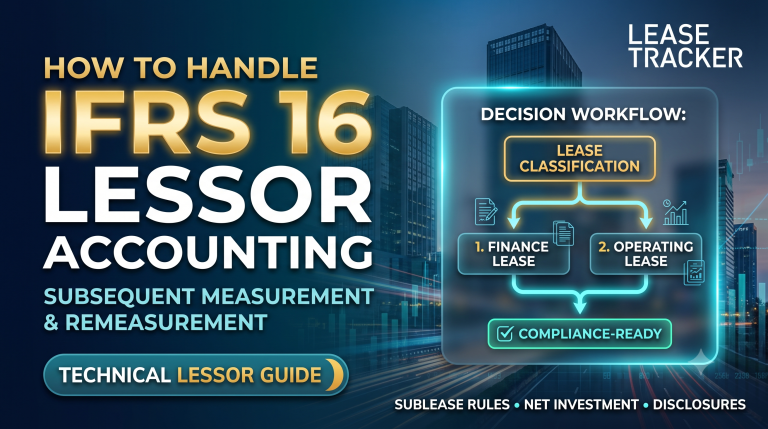
In contrast to the changes imposed on lessees, lessor accounting under IFRS 16 remains largely unchanged from IAS 17.
Lessors must continue to classify contracts into two categories at inception:
- Finance Leases: A contract that transfers substantially all the risks and rewards incidental to ownership of the underlying asset. The lessor derecognizes the underlying asset and recognizes a finance lease receivable equal to the net investment in the lease.
- Operating Leases: A contract that does not transfer substantially all the risks and rewards of ownership. The lessor keeps the asset on its balance sheet, depreciates it, and recognizes lease income on a straight-line basis over the lease term.
The IASB retained this model because investors reported that lessor accounting under IAS 17 was not fundamentally broken. However, lessors must adhere to expanded disclosure requirements, detailing their exposure to residual value risk and maturity analyses of lease receivables under IFRS 7.
8. Financial Statement Disclosure Checklist (IFRS 16.53)
To comply with the presentation and disclosure mandates of IFRS 16.53, lessees must disclose the following line items in their annual financial notes, organized into a tabular format:
- [x] Depreciation charge for ROU assets, broken down by class of underlying asset.
- [x] Interest expense on lease liabilities, presented within net finance costs.
- [x] Expense related to short-term leases utilizing the recognition exemption.
- [x] Expense related to low-value asset leases utilizing the recognition exemption.
- [x] Expense related to variable lease payments excluded from lease liabilities.
- [x] Income from subleasing ROU assets.
- [x] Total cash outflow for leases (combining operating, interest, and principal repayments).
- [x] Additions to ROU assets during the financial reporting year.
- [x] Gains or losses arising from sale and leaseback transactions.
- [x] Carrying amount of ROU assets at the end of the reporting period by asset class.
- [x] Maturity analysis of lease liabilities applying IFRS 7, disclosed separately from non-lease financial liabilities.
9. Frequently Asked Questions (FAQ)
What is the difference between the full retrospective and modified retrospective transition approaches?
The full retrospective approach requires an entity to restate every prior comparative reporting period presented, applying IFRS 16 as if it had always been in effect (as Tesco demonstrated). The modified retrospective approach does not restate comparative periods; instead, the cumulative catch-up impact is recognized directly within opening retained earnings on the initial application date, accompanied by practical expedients (as used by Deutsche Post DHL and IAG).
Does IFRS 16 impact a company’s debt covenants?
Yes, significantly. Because lease liabilities are classified as financial debt, total balance sheet leverage and gearing ratios rise. Unless banking covenants include “frozen GAAP” clauses—which compute covenant thresholds using the accounting rules in place when the debt was issued—companies risk breaching maximum leverage limits (Debt/Equity or Net Debt/EBITDA).
Why does IFRS 16 increase EBITDA if net cash outflows remain identical?
Under IAS 17, operating lease rentals were recognized inside operating costs (above EBITDA). Under IFRS 16, that rental expense is eliminated and replaced by ROU asset depreciation (added back to EBITDA) and financing interest expense (below EBITDA). While EBITDA rises, cash outflows remain identical, shifting between operating and financing cash flows.