IFRS 16 Lessor Accounting: Technical Classification, Subsequent Measurement, and Commercial Strategy
1. The Dual-Model Asymmetry: Why Lessor Accounting Was Preserved
When IFRS 16 Leases replaced IAS 17, it revolutionized lessee accounting by eliminating off-balance sheet operating leases and establishing a single, on-balance sheet model. For lessors, however, the International Accounting Standards Board (IASB) maintained the legacy dual-classification framework.
┌────────────────────────────────────────────────────────────────────────┐
│                   THE IFRS 16 ASYMMETRIC FRAMEWORK                     │
├──────────────────────────┬─────────────────────────────────────────────┤
│ LESSEE ACCOUNTING        │ LESSOR ACCOUNTING                           │
├──────────────────────────┼─────────────────────────────────────────────┤
│ Single Model             │ Dual Model (Preserved from IAS 17)          │
│ • All leases capitalized │ • Must classify every contract as either:   │
│   (ROU Asset + Liability)│   1. Finance Lease             │
│ • Operating lease concept│   2. Operating Lease           │
│   eliminated│ • Substantially unchanged mechanics│
└──────────────────────────┴─────────────────────────────────────────────┘
The IASB’s Rationale
During the standard-setting process, financial statement users reported that lessor accounting under IAS 17 was not fundamentally flawed. Lessors already reported financial assets (lease receivables) or physical assets (property, plant, and equipment) on their balance sheets, matching the underlying economics of their business models. Requiring lessors to adopt a completely new accounting model would have imposed substantial implementation costs on financial institutions, specialized leasing companies, and real estate developers without delivering commensurate benefits to investors.
Nevertheless, IFRS 16 introduces two critical operational dimensions for lessors:
- Sublease Mechanics: Intermediate lessors face strict classification rules based on the Right-of-Use (ROU) asset from the head lease rather than the underlying physical asset.
- Commercial & Structural Disruption: Because corporate tenants now record lease liabilities directly on their balance sheets, lessee behavior has fundamentally shifted toward shorter durations, flexible cancellation rights, and turnover-based rent structures.
2. Lease Classification Framework: Finance vs. Operating Leases
A lessor classifies each lease contract at the inception date. Classification is determined by the substance of the transaction rather than the legal form of the agreement.
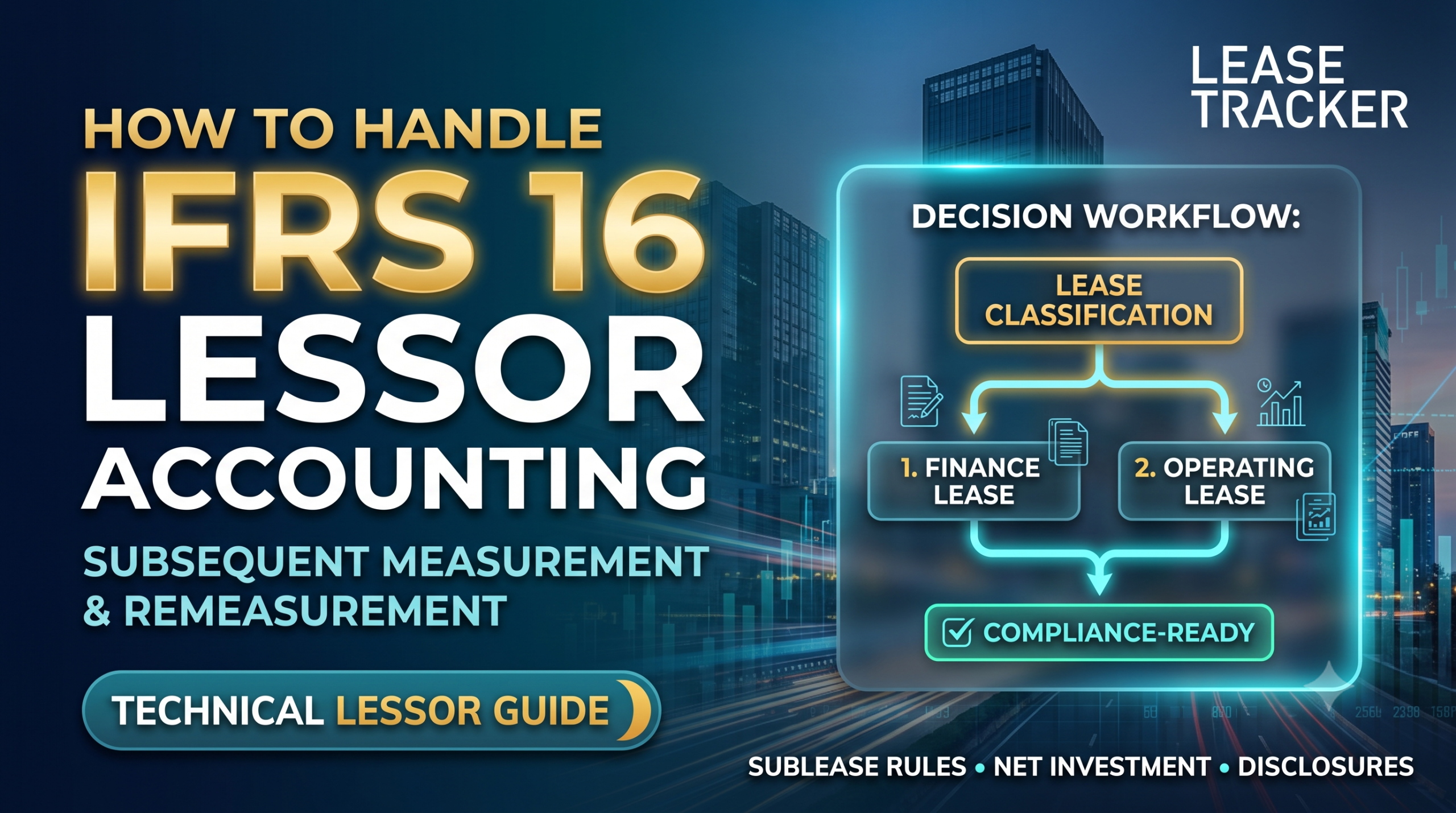
                 LESSOR CLASSIFICATION DECISION TREE
                 ═══════════════════════════════════
             Does the contract transfer substantially all the
           risks and rewards incidental to ownership of the asset?
                                   │
                    ┌──────────────┴──────────────┐
                   YES                            NO
                    │                             │
                    ▼                             ▼
              FINANCE LEASE                OPERATING LEASE
              (IFRS 16.62)                  (IFRS 16.62)
        • Derecognize underlying asset   • Keep asset on balance sheet
        • Recognize Net Investment in    • Recognize straight-line
          the Lease receivable   rental income
2.1. Defining the Classification Categories
- Finance Lease: A lease that transfers substantially all the risks and rewards incidental to ownership of an underlying asset. Title may or may not eventually be transferred.
- Operating Lease: A lease that does not transfer substantially all the risks and rewards incidental to ownership of an underlying asset.
2.2. Primary Classification Indicators (IFRS 16.63)
Whether a lease is a finance lease or an operating lease depends on the balance of risks and rewards. Indicators that individually or in combination would normally lead to a lease being classified as a finance lease include:
- Ownership Transfer: The lease transfers ownership of the underlying asset to the lessee by the end of the lease term.
- Purchase Option: The lessee has the option to purchase the asset at a price expected to be sufficiently lower than fair value at the date the option becomes exercisable, making exercise reasonably certain at inception.
- Major Economic Life: The lease term covers the major part of the economic life of the underlying asset, even if title is not transferred.
- Substantial Present Value: At inception, the present value of the minimum lease payments amounts to substantially all of the fair value of the underlying asset.
- Specialized Nature: The underlying asset is of such a specialized nature that only the lessee can use it without major modifications.
3. Technical Accounting for Finance Leases
In a finance lease, the lessor acts primarily as a financing provider. The economic substance is a financing arrangement: the lessor surrenders the asset in exchange for a stream of future cash flows and an interest return.
┌────────────────────────────────────────────────────────────────────────┐
│                   FINANCE LEASE LESSOR MECHANICS                       │
│                                                                        │
│   Initial Recognition at Commencement Date:                            │
│   ├── Derecognize the underlying physical asset from the balance sheet │
│   └── Recognize: Net Investment in the Lease (Financial Receivable)    │
│                                                              │
│                                                                        │
│   Subsequent Measurement:                                              │
│   ├── Cash Receipts: Allocated between Principal Recovery & Finance    │
│   │                  Income                                  │
│   └── Finance Income: Recognized to reflect a constant periodic rate   │
│                       of return on the net investment        │
└────────────────────────────────────────────────────────────────────────┘
3.1. Initial Measurement: Net Investment in the Lease
At the commencement date, the lessor derecognizes the carrying amount of the underlying asset and recognizes a receivable equal to the Net Investment in the Lease.
Net Investment in the Lease = PV of Gross Investment discounted at the Interest Rate Implicit in the Lease
Where the components are defined as follows:
- Gross Investment in the Lease: The aggregate of:
- The lease payments receivable by the lessor under the lease contract.
- Any unguaranteed residual value accruing to the lessor.
- Interest Rate Implicit in the Lease: The discount rate that causes the present value of (a) the lease payments and (b) the unguaranteed residual value to equal the sum of the fair value of the underlying asset and any initial direct costs of the lessor.
3.2. Initial Direct Costs
For non-manufacturer or non-dealer lessors (such as banks, leasing entities, or private asset holders), initial direct costs (e.g., commissions, legal fees, and credit origination expenses) are included in the initial measurement of the net investment in the lease. These capitalized costs automatically reduce the amount of income recognized over the lease term by adjusting the implicit interest rate downward.
3.3. Subsequent Measurement: Allocating Finance Income
- Finance Income Recognition: Paragraph 75 requires finance income to be recognized over the lease term based on a pattern reflecting a constant periodic rate of return on the lessor’s net investment in the lease.
- Principal Amortization: Each periodic lease payment received from the lessee is apportioned between finance income (credited to P&L) and a reduction of the gross lease receivable balance (credited to the balance sheet).
- Credit Risk Impairment: Because the net investment in the lease is a financial asset, lessors must apply the Expected Credit Loss (ECL) impairment model under IFRS 9 Financial Instruments. Lessors must evaluate customer credit risk and recognize appropriate loss allowances over the contract term.
4. Technical Accounting for Operating Leases
For operating leases, the lessor retains substantially all risks and rewards of asset ownership. The underlying physical asset remains capitalized on the lessor’s balance sheet, classified according to its operational nature.
4.1. Asset Presentation and Depreciation
- The underlying asset continues to be classified as Property, Plant and Equipment under IAS 16 or Investment Property under IAS 40.
- Depreciation on the underlying asset is recognized in accordance with the lessor’s normal depreciation policy for similar owned assets under IAS 16 or IAS 38.
4.2. Lease Income Recognition
- As illustrated in the accounting policies of global property groups such as Merlin Properties SOCIMI S.A., lease payments from operating leases are recognized as income on a straight-line basis over the lease term.
- A lessor may apply another systematic basis if that basis is more representative of the pattern in which benefit derived from the use of the underlying asset is diminished.
- Variable Lease Payments: Variable rental payments that do not depend on an index or rate (e.g., retail rents calculated as a percentage of tenant sales turnover) are recognized in profit or loss in the period in which the event or condition that triggers payment occurs.
4.3. Initial Direct Costs and Lease Incentives
- Initial Direct Costs: Lessors must add initial direct costs incurred in negotiating and arranging an operating lease to the carrying amount of the underlying asset. These costs are recognized as an expense over the lease term on the same straight-line basis as lease income.
- Lease Incentives: Incentives granted to lessees (e.g., rent-free introductory periods, tenant improvement contributions, or cash signing bonuses) are recognized as an integral part of net lease income. The aggregate cost of incentives is amortized on a straight-line basis over the lease term as a reduction of rental revenue.
5. Sublease Accounting: The Intermediate Lessor Rules
A frequent technical issue arises when an entity leases an asset from a primary landlord (head lease) and subsequently subleases that same asset to an independent third party (sublease). Under IFRS 16, the entity acts simultaneously as a lessee and a lessor—an intermediate lessor.
┌────────────────────────────────────────────────────────────────────────┐
│                   INTERMEDIATE LESSOR CLASSIFICATION                   │
│                                                                        │
│   CRITICAL RULE:                                                       │
│   The intermediate lessor MUST classify the sublease by reference to   │
│   the RIGHT-OF-USE (ROU) ASSET arising from the head lease,            │
│   NOT by reference to the underlying physical asset!                   │
└────────────────────────────────────────────────────────────────────────┘
Because the ROU asset typically has a significantly shorter remaining economic duration and smaller fair value than the underlying physical real estate, subleases are classified as finance leases far more frequently under IFRS 16 than under IAS 17.
┌────────────────────────────────────────────────────────────────────────┐
│               SUBLEASE CLASSIFICATION ACCOUNTING MATRIX                │
├──────────────────────────┬─────────────────────────────────────────────┤
│ Finance Sublease         │ • Derecognize ROU asset from head lease     │
│ (Sublease covers major   │ • Recognize Net Investment in Sublease      │
│ part of ROU asset term)  │   receivable                      │
│                          │ • Retain original Lease Liability from      │
│                          │   head lease on balance sheet     │
│                          │ • Recognize gain/loss on derecognition in   │
│                          │   profit or loss                  │
├──────────────────────────┼─────────────────────────────────────────────┤
│ Operating Sublease       │ • Retain ROU asset and head lease liability │
│ (Sublease covers short   │   on balance sheet                │
│ portion of ROU term)     │ • Continue straight-line ROU depreciation   │
│                          │ • Recognize straight-line sublease rental   │
│                          │   income in profit or loss        │
└──────────────────────────┴─────────────────────────────────────────────┘
Practical Corporate Disclosure: Deutsche Post DHL AG
In Note 5.2a of its annual reporting, Deutsche Post DHL AG disaggregated its diverse lease revenues to provide visibility into operating and intermediate lessor activities:
- Operating Lease Income: €49 million
- Sublease Income: €37 million
- Income from Sale and Leaseback Transactions: €46 million
By separating sublease income from core operating revenue, lessors satisfy the disclosure requirements of IFRS 16.53(f) while clarifying margin contributions from intermediation.
6. Corporate Disclosure Benchmarks: Real-World Case Studies
Global corporate annual reports demonstrate how multinational lessors implement the presentation and disclosure requirements of IFRS 16.
Case 1: Merlin Properties SOCIMI, S.A. (Spain) – Operating Leases of Investment Property
Merlin Properties SOCIMI S.A. operates as a listed real estate investment trust (REIT) managing commercial assets. In Note 5.3.2 (Lessor Accounting), the group details its operational accounting policies:
- Classification Test: Leases are classified as finance leases whenever the terms transfer substantially all risks and rewards incidental to ownership; all other contracts are classified as operating leases.
- Asset Presentation: Assets leased under operating contracts are presented within Investment Property in the consolidated statement of financial position.
- Revenue Recognition: Operating lease payments are recognized as income on a straight-line basis over the lease term.
- Cost Treatment: Depreciation is recognized systematically, while initial direct costs incurred to secure operating leases are added to the carrying amount of the investment property and amortized over the lease term.
Case 2: Tesco Plc (United Kingdom) – Managing Finance Leases as Lessor
While Tesco Plc is primarily recognized as a retail lessee, it maintains substantial lessor operations across retail parks and shopping malls. In Note 4.3b, Tesco outlines its lessor accounting policies:
- Finance Lease Receivables: Amounts due from lessees under finance leases are recognized on the balance sheet as receivables at the amount of the Group’s net investment in the leases[cite: 3].
- Allocation of Finance Income: Finance lease income is allocated to accounting periods to reflect a constant periodic rate of return on the Group’s net investment outstanding[cite: 3].
- Operating Lease Income: Rents receivable under operating leases are recognized on a straight-line basis over the full duration of the lease term[cite: 3].
7. Commercial Strategy: How IFRS 16 Reshapes Lessor Business Models
Although IFRS 16 preserved the lessor accounting mechanics of IAS 17, it triggered structural shifts across commercial leasing markets. Because lessees now face balance sheet capitalization, their procurement strategies have fundamentally changed.
┌────────────────────────────────────────────────────────────────────────┐
│             STRATEGIC LESSOR ADJUSTMENTS IN AN IFRS 16 ERA             │
├────────────────────────┬───────────────────────────────────────────────┤
│ Market Driver          │ Commercial Response by Lessors                │
├────────────────────────┼───────────────────────────────────────────────┤
│ Lessee Debt Aversion   │ Unbundling contracts: Separating maintenance, │
│                        │ service, and asset use components.  │
├────────────────────────┼───────────────────────────────────────────────┤
│ Demand for Shorter     │ Offering shorter, flexible terms at higher    │
│ Commitments            │ rental rates to offset residual risk│
├────────────────────────┼───────────────────────────────────────────────┤
│ Rise of Variable Rent  │ Structuring turnover/usage rents that lessees │
│ Structures             │ do not capitalize on day one.    │
├────────────────────────┼───────────────────────────────────────────────┤
│ Residual Value Risk    │ Sourcing third-party residual value guarantees│
│ Management             │ and developing active secondary markets│
└────────────────────────┴───────────────────────────────────────────────┘
- Contract Unbundling: Lessees increasingly request contracts that explicitly separate lease components from service components (e.g., IT hardware maintenance, building facility management, logistics handling). Service components remain fully off-balance sheet for lessees, creating commercial demand for integrated service contracts.
- Shorter Contract Durations: Lessees frequently avoid multi-decade commitments to limit balance sheet expansion. Lessors of big-ticket assets (such as commercial aircraft, rail stock, container ships, and real estate) must manage increased re-leasing and asset redeployment risk.
- Managing Residual Value Risk: Shorter lease terms leave lessors with higher unamortized asset balances at lease expiry. Lessors must actively manage unguaranteed residual values by requiring residual value guarantees (RVGs) from creditworthy counterparties, securing insurance products, or establishing secondary remarketing channels[cite: 2, 4].
8. Lessor Financial Statement Disclosure Checklist (IFRS 16.89–97)
Paragraphs 89 to 97 mandate comprehensive qualitative and quantitative disclosures to provide transparency regarding a lessor’s portfolio risks.
- [x] Disaggregation of Finance Lease Income: Disclose selling profit or loss, finance income on the net investment in the lease, and income relating to variable lease payments not included in the net investment measurement.
- [x] Operating Lease Income Breakdown: Disclose total operating lease income, with separate line items for variable lease payments that do not depend on an index or rate.
- [x] Finance Lease Maturity Analysis: Provide an undiscounted cash flow maturity schedule of lease payments receivable for each of the first 5 years and a total for the remaining years, reconciled to the net investment in the lease.
- [x] Operating Lease Maturity Analysis: Disclose an undiscounted maturity analysis of lease payments to be received for at least each of the first 5 years and a total for the remaining years.
- [x] Residual Value Risk Management: Disclose qualitative and quantitative details on how the lessor manages asset residual value risk, including risk-mitigation strategies, buy-back agreements, and residual value guarantees.
- [x] Net Investment Reconciliation: Provide a reconciliation between the opening and closing balances of the net investment in finance leases, detailing additions, finance income accrued, repayments received, and IFRS 9 ECL allowances.
9. Frequently Asked Questions (FAQ)
Why didn’t the IASB eliminate operating lease accounting for lessors?
The IASB determined that lessor accounting under IAS 17 was functioning effectively and was not characterized by the structural information gaps present in lessee accounting. Because lessors were already recognizing lease receivables or physical assets on their balance sheets, feedback from investors indicated that the cost of developing a brand-new lessor model would substantially outweigh any incremental financial reporting benefit.
How does an intermediate lessor classify a sublease under IFRS 16?
An intermediate lessor must evaluate the classification of a sublease by comparing its terms against the Right-of-Use (ROU) asset recognized from the head lease, rather than the underlying physical asset. If the sublease covers the major part of the economic life of the ROU asset (e.g., subleasing an office for the remaining 4 years of a 5-year head lease), the sublease is classified as a finance lease, even though 4 years represents a negligible fraction of the physical building’s total life[cite: 3].
How do initial direct costs differ between finance and operating leases for lessors?
- In a finance lease, initial direct costs are included directly in the initial measurement of the net investment in the lease, reducing the implicit interest rate and spreading the cost over the contract term through lower periodic finance income. (Manufacturer or dealer lessors expense these costs immediately upon selling profit recognition).
- In an operating lease, initial direct costs are added to the carrying amount of the underlying asset and recognized as an operating expense on a straight-line basis over the lease term, mirroring the recognition pattern of lease rental income.