IFRS 15 Step 3: Determining the Transaction Price — The Five Core Components, Practical Traps, and Financial Modeling
1. Executive Overview: Demystifying Step 3 (IFRS 15.47–48)
In the revenue recognition framework of IFRS 15 Revenue from Contracts with Customers, Step 3 governs the exact quantum of consideration an entity is entitled to recognize as revenue. A frequent operational pitfall is assuming that the transaction price is simply the stated contract invoice value.
Under paragraph 47, the transaction price is defined as:
The amount of consideration to which an entity expects to be entitled in exchange for transferring promised goods or services to a customer, excluding amounts collected on behalf of third parties (e.g., sales taxes, value-added taxes).
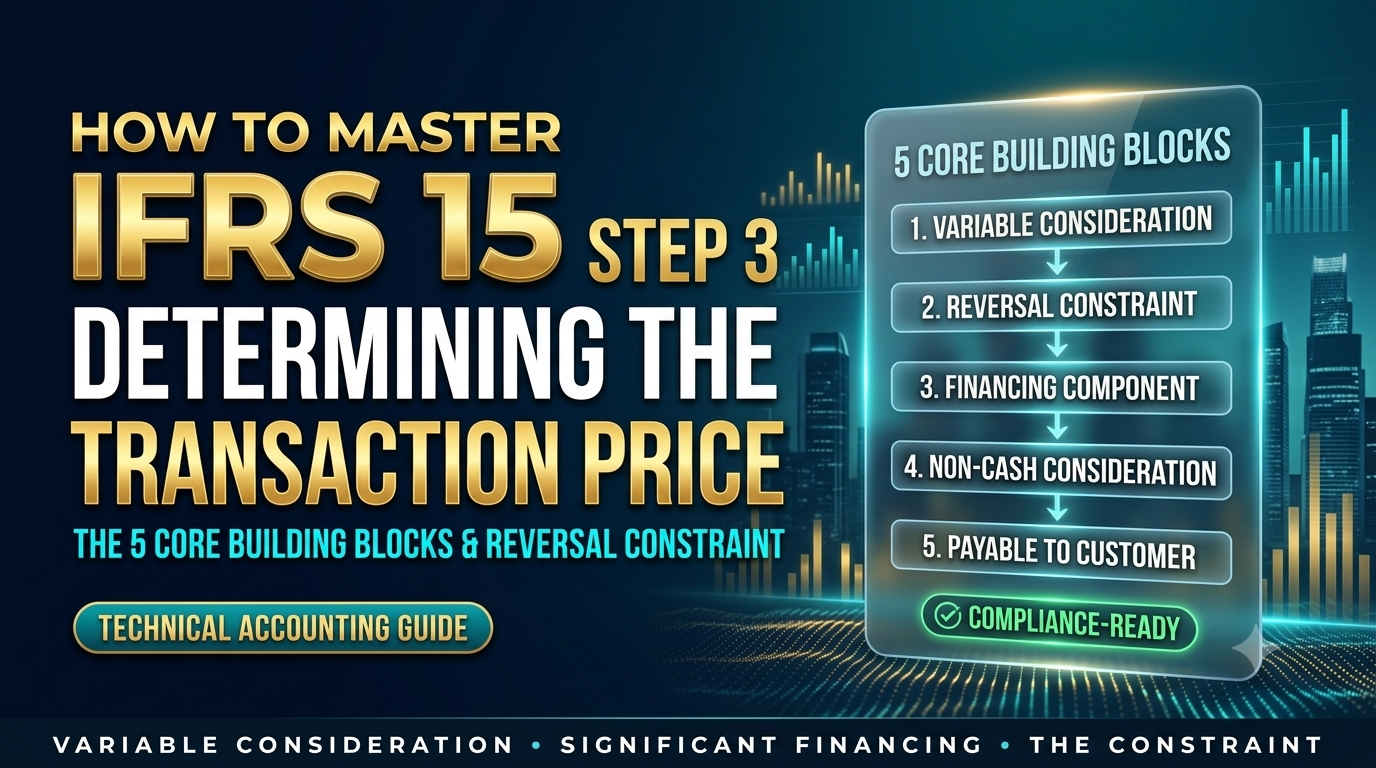
┌────────────────────────────────────────────────────────────────────────┐
│           THE FIVE BUILDING BLOCKS OF TRANSACTION PRICE (IFRS 15.48)   │
├────────────────────────────────────────────────────────────────────────┤
│ 1. Variable Consideration (IFRS 15.50–55)                              │
│ 2. The Variable Consideration Constraint (IFRS 15.56–58)               │
│ 3. Significant Financing Component (IFRS 15.60–65)                     │
│ 4. Non-Cash Consideration (IFRS 15.66–69)                              │
│ 5. Consideration Payable to a Customer (IFRS 15.70–72)                 │
└────────────────────────────────────────────────────────────────────────┘
Paragraph 48 mandates that an entity determine the transaction price by considering the terms of the contract alongside its customary business practices. This requires finance teams to look beyond legal boilerplate and assess commercial realities, past behavior, and pricing concessions.
2. In-Depth Technical Breakdown of the 5 Building Blocks
2.1. Variable Consideration (IFRS 15.50–55)
Consideration is variable whenever the contract includes terms such as discounts, volume rebates, performance bonuses, liquidated damages, penalties, prompt payment incentives, or contractual rights of return.
                 ESTIMATION METHODOLOGIES (IFRS 15.53)
                 ═════════════════════════════════════
          Select the method that best predicts the entitled amount:
                                   │
                    ┌──────────────┴──────────────┐
                   ▼                             ▼
       EXPECTED VALUE METHOD           MOST LIKELY AMOUNT METHOD
  • Sum of probability-weighted       • The single most likely outcome
    amounts across a range of           in a range of possible
    possible outcomes.                  outcomes.
  • Appropriate for LARGE NUMBERS     • Appropriate when the contract
    of contracts with similar           has only TWO OUTCOMES (e.g.,
    characteristics.                    achieving a bonus or not)[cite: 11, 14].
- Explicit vs. Implicit Variability: Consideration is variable not only when stated in the agreement, but also when customary business practices, published policies, or oral representations create a valid customer expectation that the entity will accept a discounted amount (an implicit price concession).
- Consistent Application: An entity must select one estimation method and apply it consistently across the entire contract lifecycle.
2.2. The Variable Consideration Constraint (IFRS 15.56–58)
The constraint prevents entities from recognizing speculative variable revenue. Under paragraph 56, an entity includes variable consideration in the transaction price only to the extent that it is highly probable that a significant reversal in the cumulative revenue recognized will not occur when the uncertainty is resolved.
                 THE VARIABLE CONSIDERATION CONSTRAINT
                 ═════════════════════════════════════
          Is it HIGHLY PROBABLE that a significant reversal in
         cumulative revenue will NOT occur when the uncertainty
                       is subsequently resolved?
                                   │
                    ┌──────────────┴──────────────┐
                   YES                            NO
                    │                             │
                    ▼                             ▼
       INCLUDE IN TRANSACTION PRICE     RESTRICT / CONSTRAIN REVENUE
     Recognize revenue based on full    Recognize revenue ONLY up to the
     estimated amount[cite: 11, 14].   amount that is highly probable
                                        of not reversing.
Reversal Indicators (IFRS 15.57):
- The amount is highly susceptible to factors outside the entity’s influence (e.g., market volatility, weather, third-party actions).
- The uncertainty is not expected to be resolved for a protracted period.
- The entity has limited historical experience with similar contracts.
- The entity has a history of offering discretionary price concessions.
- The contract has a broad range of possible consideration amounts.
2.3. Significant Financing Component (IFRS 15.60–65)
The objective of adjusting for a significant financing component is to recognize revenue at the cash selling price that the customer would have paid at the time of transferring control of the promised goods or services.
┌────────────────────────────────────────────────────────────────────────┐
│             FINANCING COMPONENT CLASSIFICATION & ACCOUNTING            │
├──────────────────────────┬─────────────────────────────────────────────┤
│ Structure                │ Economic Nature & Accounting Impact         │
├──────────────────────────┼─────────────────────────────────────────────┤
│ Deferred Payment         │ • Entity provides financing to customer     │
│ (Customer pays late)     │  .                           │
│                          │ • Recognize Revenue at present value        │
│                          │   (cash price) and accrete **Finance        │
│                          │   Income** over time.        │
├──────────────────────────┼─────────────────────────────────────────────┤
│ Advance Payment          │ • Customer provides financing to entity     │
│ (Customer pays upfront)  │  .                           │
│                          │ • Accrete **Finance Expense** over time,    │
│                          │   increasing the Contract Liability         │
│                          │   recognized before revenue release         │
│                          │  [cite: 14, 16, 21].                       │
└──────────────────────────┴─────────────────────────────────────────────┘
Key Exemptions (IFRS 15.62 & 15.63):
- Practical Expedient (IFRS 15.63): No financing adjustment is required if the period between performance and payment is one year or less.
- Customer Discretion (IFRS 15.62(a)): Payment timing is driven by customer option (e.g., prepaid customer loyalty points, gift cards).
- Variable Consideration Outside Parties’ Control (IFRS 15.62(b)): The consideration varies based on an external future event outside the control of either party (e.g., a sales-based royalty).
- Protective Terms (IFRS 15.62(c)): The payment difference provides security/assurance rather than financing (e.g., standard construction retainage held until defect liability periods lapse).
2.4. Non-Cash Consideration (IFRS 15.66–69)
When a customer promises consideration in a form other than cash (e.g., equity instruments, property, plant, equipment, or barter goods):
- Measurement Date: The entity measures non-cash consideration at fair value at contract inception.
- Indirect Measurement: If fair value cannot be reasonably estimated, the entity measures the consideration indirectly by reference to the Standalone Selling Price (SSP) of the promised goods/services.
- Subsequent Fair Value Fluctuations: Changes in fair value attributable to the form of the consideration (such as equity price movements) are accounted for under IFRS 9 Financial Instruments, not IFRS 15, and do not adjust revenue.
2.5. Consideration Payable to a Customer (IFRS 15.70–72)
Consideration payable to a customer includes cash amounts paid (or expected to be paid), credits, vouchers, or slotting fees.
                 CONSIDERATION PAYABLE TO A CUSTOMER
                 ═══════════════════════════════════
       Is the payment made in exchange for a DISTINCT GOOD OR
                   SERVICE from the customer?
                                   │
                    ┌──────────────┴──────────────┐
                   YES                            NO
                    │                             │
                    ▼                             ▼
       ACCOUNT FOR AS A PURCHASE          REDUCTION OF REVENUE
     Account for as an operating        Recognize as a direct reduction
     expense/cost (IAS 2 / IAS 16)      of the Transaction Price and
     up to fair value.                  Revenue.
If the payment exceeds the fair value of the distinct good or service received from the customer, the entity must account for the excess as a direct reduction of the transaction price.
3. High-Risk Technical Pitfalls in Step 3
Trap 1: Price Concessions vs. IFRS 9 Bad Debt
A persistent source of audit adjustments is confusing an implicit price concession with customer credit deterioration:
- Implicit Price Concession (IFRS 15 Step 3): If an entity enters into a contract knowing from past commercial practice that it will not collect the full contracted amount, the uncollected portion is a price concession. It reduces the transaction price and revenue on day one.
- Credit Loss / Impairment (IFRS 9): If an entity has an enforceable right to the full contracted price and fully expects to collect it at contract inception, any subsequent default due to customer insolvency is recorded as an Impairment Expense (Bad Debt) within operating expenses. It never reduces revenue.
Trap 2: The Intellectual Property Royalties Exception (IFRS 15.B63)
For licenses of intellectual property where consideration is structured as a sales-based or usage-based royalty:
- The standard overrides the general variable consideration estimation model.
- An entity is prohibited from estimating future royalties and recognizing revenue upfront, even if historical predictive models exist.
- Revenue can only be recognized as the customer’s underlying subsequent sales or usage occur.
Trap 3: Sales with a Right of Return (IFRS 15.B20–B27)
A right of return is not a distinct performance obligation; it is a form of variable consideration. Under IFRS 15, entities must account for returns using gross presentation:
- Revenue: Recognized only for goods expected not to be returned.
- Refund Liability: Recognized for the consideration expected to be refunded to customers (presented within payables).
- Asset for Right to Recover Products: Recognized as a balance sheet asset (measured at the former carrying amount of the inventory less recovery costs), reducing Cost of Goods Sold.
4. Comprehensive Numerical Case Studies & Journal Entries
Case Study 1: Volume Rebate with the Constraint & Cumulative Catch-Up
- Scenario: Chemical Vendor V agrees to supply industrial solvents to Manufacturer M throughout 2026 at a list price of $100 per drum.
- Rebate Structure: If M purchases more than 1,000 drums during 2026, the price retroactively drops to $80 per drum across all orders.
- Q1 Activity: V delivers 250 drums to M and invoices $25,000 ($100 x 250) cash.
- Q1 Evaluation: Based on M’s factory expansion, V assesses that it is highly probable that M will exceed 1,000 drums.
- Transaction Price: Constrained to $80 per drum.
Q1 Journal Entries:
Revenue Recognized = 250 x $80 = $20,000
Refund Liability = 250 x ($100 – $80) = $5,000
JOURNAL ENTRY (Q1 2026):
Dr. Cash                                      $25,000
    Cr. Revenue (IFRS 15)                                   $20,000
    Cr. Refund Liability (Rebate Provision)                  $5,000
(To record delivery of 250 drums subject to retrospective volume rebate)
Q2 Reassessment:
During Q2, M’s manufacturing plant experiences unexpected shutdowns. At June 30, 2026, V reassesses M’s purchasing trajectory and concludes it is now highly probable that M will NOT reach 1,000 drums. In Q2, V sells another 100 drums for $10,000 cash.
- Reassessed Cumulative Price: $100 per drum across all 350 drums.
- Cumulative Revenue Target: 350 x $100 = $35,000
- Revenue Previously Recognized (Q1): $20,000
- Q2 Cumulative Catch-Up Revenue: $35,000 – $20,000 = $15,000
JOURNAL ENTRY (Q2 2026):
Dr. Cash                                      $10,000
Dr. Refund Liability (Reversal)                $5,000
    Cr. Revenue (IFRS 15)                                   $15,000
(To record Q2 sales and cumulative catch-up reversing prior volume rebate constraint)
Case Study 2: Deferred Payment Terms (Significant Financing Component)
- Scenario: Machinery Manufacturer M delivers specialized equipment to Client C on January 1, 2026.
- Payment Terms: Client C agrees to pay a single lump sum of $1,210,000 exactly 2 years later on December 31, 2027.
- Cash Price & Interest: The cash selling price of the equipment on delivery date is $1,000,000. The market financing rate reflecting C’s credit risk is 10% per annum ($1,000,000 x 1.10^2 = $1,210,000.
Delivery Date Journal Entry (January 1, 2026):
Plaintext
Dr. Trade / Contract Receivable               $1,000,000
    Cr. Revenue (IFRS 15 - Cash Selling Price)              $1,000,000
(To recognize revenue at delivery measured at cash selling price)
Year 1 Accretion (December 31, 2026):
Finance Income Year = $1,000,000 x 10% = $100,000
Dr. Trade / Contract Receivable                 $100,000
    Cr. Finance Income (P&L - Effective Interest)             $100,000
(To record financing component unwinding for Year 1)
Year 2 Accretion & Settlement (December 31, 2027):
Finance Income Year 2 = ($1,000,000 + $100,000) x 10% = $110,000
1. Record Year 2 Finance Income:
Dr. Trade / Contract Receivable                 $110,000
    Cr. Finance Income (P&L - Effective Interest)             $110,000

2. Record Cash Receipt upon Maturity:
Dr. Cash                                      $1,210,000
    Cr. Trade / Contract Receivable                         $1,210,000
(To record full collection of deferred payment and interest receivable)
5. Mandatory Disclosure Checklist (IFRS 15.126)
Preparers must ensure financial statement disclosures fulfill the requirements of paragraph 126:
- [x] Estimation Methods: Disclose the methods, inputs, and assumptions used to estimate variable consideration (Expected Value vs. Most Likely Amount).
- [x] Assessment of the Constraint: Disclose the qualitative and quantitative judgments used to evaluate the constraint and determine that a significant reversal is not highly probable.
- [x] Financing Component Presentation: Present finance income or finance expense distinctly from revenue from contracts with customers on the face of the P&L.
- [x] Reversals from Prior Periods: Disclose the amount of revenue recognized in the reporting period resulting from performance obligations satisfied (or partially satisfied) in prior periods due to changes in transaction price estimates.
- [x] Return Liabilities & Assets: Disclose the carrying amounts of refund liabilities and return asset recovery balances on the statement of financial position.
6. Advanced Practical FAQs
Is a prompt-payment cash discount treated as a financing component or variable consideration?
Prompt-settlement terms (e.g., “2/10 net 30”) are accounted for as variable consideration, not a financing component. The entity must estimate upfront whether the customer will claim the discount and constrain revenue accordingly.
Are transaction prices reallocated if Standalone Selling Prices (SSPs) change after inception?
No. Paragraph 88 strictly prohibits reallocating the transaction price to reflect subsequent changes in standalone selling prices. Any subsequent changes in the transaction price itself are allocated to performance obligations on the relative SSP basis established at contract inception.
How are liquidated damages for delivery delays presented in the financial statements?
Liquidated damages reduce the transaction price directly under paragraph 5. They are presented as a reduction of revenue, never as an operating expense.