Mastering Contract Modifications Under IFRS 15: A Comprehensive Accounting Guide
When executing long-term commercial contracts, amendments, change orders, and scope variations are an everyday reality. Under legacy standards like IAS 18, handling changes could often feel ambiguous or inconsistent. However, IFRS 15 Revenue from Contracts with Customers provides a rigorous, structured decision framework for evaluating and accounting for contract modifications.
Whether you are in construction, software development, telecommunications, or heavy manufacturing, getting contract modification accounting wrong can lead to major financial restatements, inaccurate revenue timing, and compliance scrutiny.
In this deep-dive blog, we break down what constitutes a contract modification, the core accounting models, and practical application rules under IFRS 15.
1. What is a Contract Modification under IFRS 15?
According to IFRS 15.18, a contract modification is defined as:
A change in the scope or price (or both) of a contract that is approved by the parties to the contract.
In practice, these are frequently called change orders, variations, or amendments. A critical baseline rule under IFRS 15 is that adjustments are only made when the modification creates new, or changes existing, enforceable rights and obligations.
The Approval Rule
If the parties agree to a scope change verbally, in writing, or via customary business practices, but have not yet agreed on the price (an unpriced change order), the entity must estimate the change to the transaction price. This estimation relies on standard variable consideration and constraint guidance (IFRS 15.19). If a modification lacks legal enforceability or approval, the entity must continue applying the revenue standard to the existing contract until formal approval is reached.
2. The Three-Path Accounting Framework for Contract Modifications
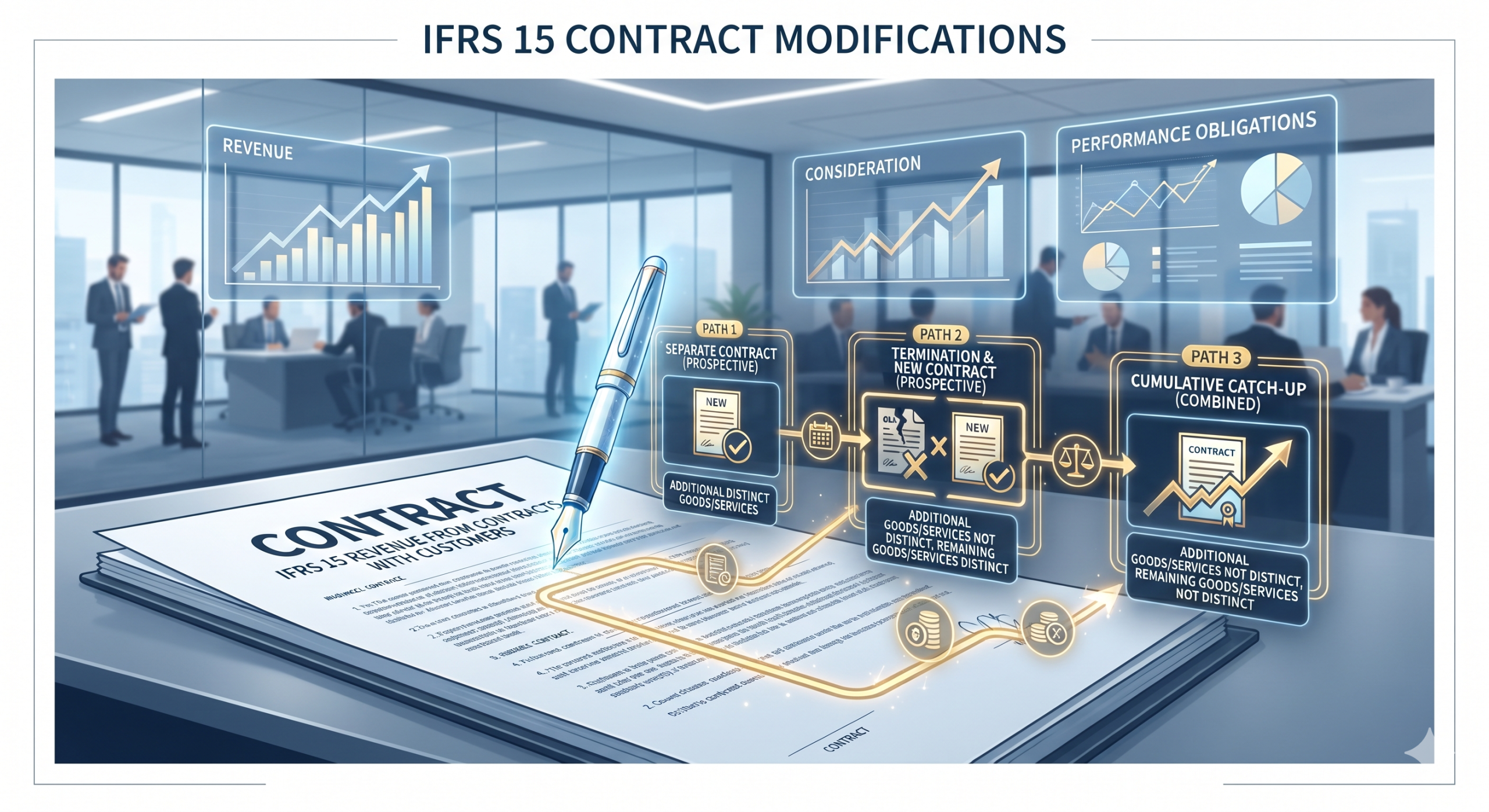
Once a modification is approved, IFRS 15 mandates that an entity evaluate the remaining goods or services to determine which of the three distinct accounting models applies:
                       CONTRACT MODIFICATION DECISION TREE
                       ═══════════════════════════════════
                    Are new goods/services DISTINCT and priced
                     at Stand-Alone Selling Prices (SSP)?
                                   │
                     ┌─────────────┴─────────────> YES ──► Model 1: Separate Contract
                     ▼ NO                                   (Prospective Treatment)
           Are the remaining goods/services
                DISTINCT from those
               transferred to date?
                     │
                     ┌─────────────┴─────────────> YES ──► Model 2: Termination & New Contract
                     ▼ NO                                   (Prospective Treatment)
                                                           ──► Model 3: Cumulative Catch-Up
                                                                  (Combined Basis)
Model 1: Account for as a Separate Contract (Prospective Treatment)
IFRS 15.20 dictates that a contract modification is accounted for as an entirely separate contract if both conditions are met:
- Distinct Scope: The scope of the contract increases due to the addition of promised goods or services that are distinct (under IFRS 15.26–30). HTML
- Standalone Pricing: The price of the contract increases by an amount of consideration that reflects the entity’s stand-alone selling prices (SSP) of the additional goods or services, adjusted for specific contract circumstances (such as cost savings from avoiding new customer acquisition costs). HTML
- Accounting Effect: The original contract remains completely unchanged, and the new goods/services are tracked independently. PDF
Model 2: Termination of Existing Contract and Creation of a New Contract (Prospective Treatment)
If the modification does not qualify as a separate contract, but the remaining goods or services are distinct from the goods and services transferred on or before the modification date, the entity accounts for it as if the old contract was terminated and a new contract was created.
- How it works:
- Cumulative revenue recognized prior to the modification date is not reversed or restated.
- The remaining consideration (the total transaction price less revenue recognized to date) plus the consideration for the modification is combined and allocated to the remaining unsatisfied performance obligations.
- Handling Contract Assets: If a contract asset exists at the modification date, it is not written off against revenue; instead, it is carried forward to the new contract (subject to regular impairment reviews) to preserve historical accounting accuracy.
Model 3: Part of the Original Contract (Cumulative Catch-Up Adjustment)
If the modification does not add distinct goods or services (meaning the remaining goods/services are interdependent or combined with the original bundle into a single performance obligation), the entity treats the modification as part of the original contract.
- Accounting Effect: The modification is accounted for via a cumulative catch-up adjustment at the date of modification. Revenue is adjusted upward or downward immediately in profit or loss to reflect how the combined contract would have been accounted for from inception.
3. Complex Practical Scenarios & Industry Insights
A. Modifications Involving Compensation for Past Poor Performance
Special care is required when a contract modification reduces the price of remaining goods as compensation for past poor performance or service failures. BDO and major accounting firms highlight that entities must meticulously separate:
- The retrospective adjustment representing compensation for past services (which hits revenue immediately).
- The prospective pricing for future remaining deliverables.
B. Series Guidance and Modifications
When applying IFRS 15 “series guidance” (distinct goods or services provided consecutively that form a single performance obligation, such as daily cleaning or routine IT support), a modification must be evaluated against the underlying distinct goods and services within the series rather than the overarching performance obligation structure.
4. Key Takeaways for Finance & Accounting Teams
- Substance over Form: Do not rely solely on how a document is titled (e.g., “change order” vs. “amendment”). Evaluate whether enforceable rights and obligations have actually shifted.
- Assess Distinctness Early: Determine whether added goods/services can stand alone and are distinct under Step 2 criteria.
- Monitor Contract Assets: Ensure contract assets are carried forward safely during prospective contract terminations to avoid unintended revenue reversals.
Proper documentation and rigorous technical accounting alignment will ensure your organization stays fully compliant with IFRS 15 while protecting your bottom line from erratic revenue volatility.