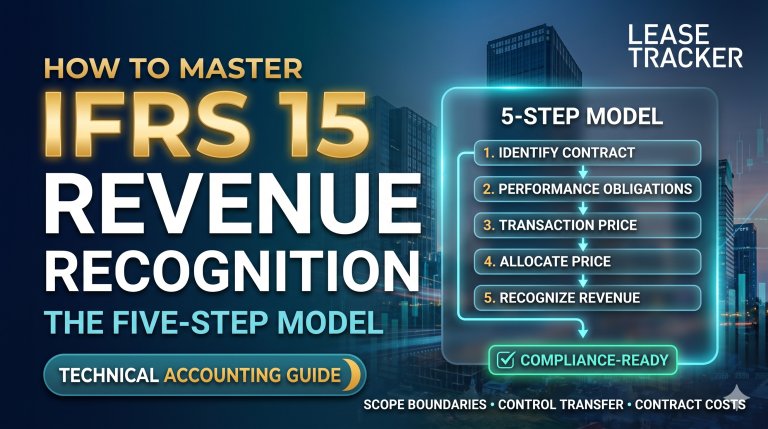
IFRS 15 Step 5: Recognizing Revenue Over Time vs. at a Point in Time — Criteria, Progress Measurement, and Practical Implementation
1. Executive Summary: The Control Model (IFRS 15.31–34)
Under IFRS 15 Revenue from Contracts with Customers, the recognition of revenue is governed entirely by the transfer of control. This principle represents a fundamental departure from legacy standard IAS 18 Revenue, which focused primarily on the transfer of “risks and rewards”. Under IFRS 15, an assessment of risks and rewards is merely one of several indicators used to determine whether control has passed.
Paragraph 31 dictates the core principle of Step 5:
An entity shall recognize revenue when (or as) the entity satisfies a performance obligation by transferring a promised good or service (i.e., an asset) to a customer. An asset is transferred when (or as) the customer obtains control of that asset.
┌────────────────────────────────────────────────────────────────────────┐
│                   THE DEFINITION OF CONTROL (IFRS 15.33)               │
├────────────────────────────────────────────────────────────────────────┤
│ Control of an asset refers to:                                         │
│ 1. The ability to DIRECT THE USE OF the asset; and                     │
│ 2. The ability to OBTAIN SUBSTANTIALLY ALL OF THE REMAINING BENEFITS   │
│    (cash inflows or reduction of cash outflows) from the asset.        │
│                                                                        │
│ Control also encompasses the ability to PREVENT other entities from    │
│ directing the use of, and obtaining the benefits from, the asset.      │
└────────────────────────────────────────────────────────────────────────┘
At contract inception, an entity must evaluate every distinct performance obligation identified in Step 2 to determine whether it is satisfied over time or at a point in time. If a performance obligation does not meet any of the three criteria for over-time recognition, it is defaulted to point-in-time recognition.
2. Criteria for Over-Time Revenue Recognition (IFRS 15.35)
An entity transfers control of a good or service over time—and therefore satisfies a performance obligation and recognizes revenue over time—if at least one of the following three criteria is met:
                       OVER-TIME RECOGNITION DECISION TREE
                       ═══════════════════════════════════
        Does the performance obligation meet AT LEAST ONE criterion?
                                   │
     ┌─────────────────────────────┼─────────────────────────────┐
     ▼                             ▼                             ▼
CRITERION 35(a)              CRITERION 35(b)               CRITERION 35(c)
Customer simultaneously      Customer controls the         Asset has no alternative
receives and consumes        asset as it is created        use AND entity has an
benefits as entity performs  or enhanced by the entity     enforceable right to payment
[cite: 2, 4].              .                    for performance to date.
     │                             │                             │
     └─────────────────────────────┼─────────────────────────────┘
                                   │
                                  YES ──► RECOGNIZE REVENUE OVER TIME
                                   │
                                   NO ──► RECOGNIZE AT A POINT IN TIME
                                          (Evaluate IFRS 15.38 indicators)
Criterion 35(a): Customer Simultaneously Receives and Consumes Benefits
- Mechanism: The customer receives and consumes the benefits of the entity’s performance as the entity performs.
- The “Hypothetical Replacement” Test (IFRS 15.B3–B4): To determine whether a customer simultaneously receives and consumes benefits, an entity evaluates whether another entity would need to substantially reperform the work completed to date if that other entity were to take over the remaining performance obligation.
- Irrelevance of Contractual Restrictions (IFRS 15.BC139): Potential contractual restrictions or practical limitations that would prevent the actual replacement of the entity are ignored when assessing this hypothetical question.
- Typical Examples: Routine cleaning services, recurring IT payroll processing, security guard services, and freight transportation.
Example (Freight Transportation – IFRS 15.BC126): Company M contracts to transport cargo from Los Angeles to New York. If M delivers the cargo halfway to Denver, another logistics provider taking over the contract would only need to haul the cargo from Denver to New York without returning the cargo back to Los Angeles. Because the replacement entity does not reperform the leg completed, Criterion 35(a) is met, and transportation revenue is recognized over time.
Criterion 35(b): Performance Creates or Enhances a Customer-Controlled Asset
- Mechanism: The entity’s performance creates or enhances an asset (such as work-in-progress) that the customer controls as the asset is created or enhanced.
- Application Focus: Focuses on situations where the asset physically sits on the customer’s property or where legal control over work-in-progress vests with the customer continuously throughout production.
- Typical Examples: Constructing a commercial facility on land owned by the customer, or performing structural renovations on a customer-owned airplane or vessel.
Criterion 35(c): No Alternative Use + Enforceable Right to Payment
Criterion 35(c) is the most scrutinized and complex criterion in corporate accounting, particularly across real estate, defense contracting, and heavy industrial manufacturing. It requires both of the following conditions to be present simultaneously[cite: 2]:
┌────────────────────────────────────────────────────────────────────────┐
│                   CRITERION 35(c) DUAL REQUIREMENT                     │
├──────────────────────────┬─────────────────────────────────────────────┤
│ Condition 1:             │ The asset created does not have an          │
│ No Alternative Use       │ alternative use to the entity (assessed at  │
│ (IFRS 15.36, B6–B8)      │ contract inception).           │
├──────────────────────────┼─────────────────────────────────────────────┤
│ Condition 2:             │ The entity has an enforceable right to      │
│ Enforceable Right        │ payment for performance completed to date   │
│ to Payment (IFRS 15.37)  │ throughout the duration of the contract     │
│                          │.                               │
└──────────────────────────┴─────────────────────────────────────────────┘
1. Assessing “No Alternative Use” (Contractual vs. Practical)
An asset does not have an alternative use if the entity is restricted either contractually or practically from directing the asset to another customer[cite: 3, 4]:
- Contractual Restrictions (IFRS 15.B7): Enforceable terms in the agreement prohibit the entity from transferring the specific customized asset to another customer (e.g., proprietary military equipment built under government design security classifications).
- Practical Limitations (IFRS 15.B8): The entity would incur significant economic losses to redirect the asset for another use. Economic losses arise from incurring significant costs to rework the asset or being forced to sell it at a substantial discount. Design specifications unique to a customer create a practical limitation.
2. Assessing the “Enforceable Right to Payment for Performance Completed to Date”
Under paragraph 37, an enforceable right to payment must exist at all times throughout the contract duration. The payment right must cover:
- Full reimbursement for costs incurred to date; PLUS
- A reasonable profit margin (representing a proportionate return on the cost of capital or standard operating margins).
The Termination Test: If the customer terminates the contract for reasons other than the entity’s failure to perform (e.g., termination for convenience), the contract terms or governing law must give the entity the legal right to enforce payment for performance completed to date (including reasonable profit). If the entity is only entitled to recover costs, or only a fixed forfeiture deposit, Criterion 35(c) fails, and revenue cannot be recognized over time[cite: 2].
3. Measuring Progress Toward Complete Satisfaction Over Time (IFRS 15.39–45)
When a performance obligation is satisfied over time, revenue is recognized only if the entity can reasonably measure its progress toward complete satisfaction of that obligation. IFRS 15 permits two overarching methods: Output Methods and Input Methods.
┌────────────────────────────────────────────────────────────────────────┐
│               OUTPUT METHODS VS. INPUT METHODS COMPARISON              │
├───────────────────┬──────────────────────────┬─────────────────────────┤
│ Dimension         │ Output Methods (15.B15)  │ Input Methods (15.B18)  │
├───────────────────┼──────────────────────────┼─────────────────────────┤
│ Definition        │ Recognizes revenue based │ Recognizes revenue based│
│                   │ on direct measurements   │ on the entity's efforts │
│                   │ of value transferred to  │ or inputs relative to   │
│                   │ the customer to date.    │ total expected inputs   │
│                   │                          │.                        │
├───────────────────┼──────────────────────────┼─────────────────────────┤
│ Common Metrics    │ • Surveys of performance │ • Cumulative costs      │
│                   │ • Milestones reached     │   incurred (cost-to-cost│
│                   │ • Units produced/shipped │   method)[cite: 2, 5]   │
│                   │ • Time elapsed           │ • Labor hours expended  │
│                   │                          │ • Machine hours         │
├───────────────────┼──────────────────────────┼─────────────────────────┤
│ Key Advantage     │ Directly depicts the     │ Easily tracked through  │
│                   │ transfer of value to the │ internal enterprise ERP │
│                   │ customer.                │ and job-costing engines.│
├───────────────────┼──────────────────────────┼─────────────────────────┤
│ Practical Hurdle  │ Output data may not be   │ Distortion caused by    │
│                   │ directly observable      │ uninstalled materials   │
│                   │ without costly appraisal │ and operational waste   │
│                   │ studies.                 │.              │
└───────────────────┴──────────────────────────┴─────────────────────────┘
3.1. The Cost-to-Cost Input Method Formula
Under the input method, the proportion of progress achieved is calculated as:
Percentage of Completion = Cumulative Cumulative Contract Costs Incurred to Date/Total Estimated Contract Costs to Complete
Cumulative Cumulative Revenue} = Percentage of Completion x Total Transaction Price
3.2. Crucial Adjustments to Input Costs: Uninstalled Materials (IFRS 15.B19)
A common technical compliance trap occurs when an entity incurs significant procurement expenditures at contract inception for materials delivered to the site before installation.
Under paragraph B19, an entity must exclude the cost of uninstalled materials from the progress calculation if their inclusion would overstate progress. Instead, revenue is recognized at zero profit margin (revenue equals the exact cost of the material) if all four of the following conditions are met at contract inception:
- The good is not distinct.
- The customer is expected to obtain control of the good significantly before receiving services related to the good.
- The cost of the transferred good is significant relative to the total expected contract costs.
- The entity procures the good from a third party and is not involved in designing or manufacturing the good.
CORRECTION FORMULA (EXCLUDING UNINSTALLED MATERIALS):

                     Cumulative Costs Incurred (Excl. Uninstalled Materials)
Progress % = ──────────────────────────────────────────────────────────────────────────
             Total Estimated Contract Costs (Excl. Uninstalled Materials)

Cumulative Revenue = [Progress % × (Transaction Price - Cost of Uninstalled Materials)]
                     + Cost of Uninstalled Materials
3.3. Abnormal Inefficiencies and Wasted Materials
Under paragraph B19(a), input costs must be adjusted to exclude the costs of wasted materials, labor inefficiencies, or other costs incurred that do not contribute to progress toward satisfying the performance obligation. Such operational waste is expensed immediately in operating profit and excluded from cumulative revenue progress calculations.
3.4. The Practical Expedient: Right to Invoice (IFRS 15.B16)
If an entity has a right to consideration from a customer in an amount that corresponds directly with the value to the customer of the entity’s performance completed to date (e.g., a service contract billing a fixed rate of $150 per direct labor hour), the entity may recognize revenue in the exact amount to which it has the right to invoice.
4. Point-in-Time Revenue Recognition (IFRS 15.38)
If a performance obligation is not satisfied over time under paragraph 35, it is satisfied at a point in time. Control transfers when the customer obtains the ability to direct the use of and receive the benefits from the asset.
Paragraph 38 lists non-exhaustive indicators of the transfer of control:
┌────────────────────────────────────────────────────────────────────────┐
│             INDICATORS OF THE TRANSFER OF CONTROL (IFRS 15.38)         │
├──────────────────────────┬─────────────────────────────────────────────┤
│ Indicator                │ Operational Evaluation                      │
├──────────────────────────┼─────────────────────────────────────────────┤
│ 1. Present Right         │ The customer is currently obliged to pay    │
│    to Payment            │ for the asset (indicates vendor has         │
│                          │ transferred consideration rights).          │
├──────────────────────────┼─────────────────────────────────────────────┤
│ 2. Legal Title           │ The customer has legal title to the asset   │
│                          │ (or vendor retains legal title solely as    │
│                          │ protection against customer default).       │
├──────────────────────────┼─────────────────────────────────────────────┤
│ 3. Physical Possession   │ The customer has physical possession of the │
│                          │ asset (holding the physical utility).       │
├──────────────────────────┼─────────────────────────────────────────────┤
│ 4. Significant Risks &   │ The customer bears inventory risk, price    │
│    Rewards of Ownership  │ obsolescence, and physical casualty risk.   │
├──────────────────────────┼─────────────────────────────────────────────┤
│ 5. Customer Acceptance   │ The customer has formally accepted the good │
│                          │ or service per contract specifications      │
│                          │.                                  │
└──────────────────────────┴─────────────────────────────────────────────┘
5. High-Risk Practical Application Scenarios
Scenario 1: Customer Acceptance Clauses (IFRS 15.B83–B86)
- Objective Test (B84): If an entity can objectively test and demonstrate that the promised goods conform to contract specifications (e.g., standard industrial metal beams meeting certified chemical purity thresholds), customer acceptance is a formality. Revenue is recognized upon delivery before formal sign-off, provided all other control indicators are satisfied.
- Subjective Test (B85): If the entity cannot objectively determine conformity (e.g., customized enterprise software, bespoke artistic design, trial periods), control does not transfer until the customer formally accepts the asset or the acceptance period lapses.
Scenario 2: Bill-and-Hold Arrangements (IFRS 15.B79–B82)
In a bill-and-hold arrangement, an entity invoices a customer for a product but retains physical possession until a later delivery date. To recognize revenue before physical delivery, all four criteria must be met:
- The reason for the bill-and-hold request must be substantive (requested by the customer due to warehouse capacity constraints).
- The product must be identified separately as belonging to the customer.
- The product must be ready for physical transfer.
- The entity cannot have the ability to use the product or direct it to another customer.
Scenario 3: Licensing of Intellectual Property (IFRS 15.B52–B62)
Determining Step 5 timing for intellectual property licenses requires classifying the license nature:
- Right to Access IP (Over Time): The contract requires or the customer reasonably expects the entity to undertake activities that significantly affect the intellectual property (dynamic IP, such as sports franchise branding, cloud software updates). Revenue is recognized over the license term.
- Right to Use IP (Point in Time): The intellectual property has significant standalone functionality and the entity is not required to undertake updating activities (static IP, such as completed film releases, perpetual on-premise software keys). Revenue is recognized at the point in time when the software key or media is made available.
6. Comprehensive Numerical Case Studies & Journal Entries
Case Study 1: Over-Time EPC Construction with Uninstalled Materials
- Contract Overview: Global EPC Contractor G enters into a fixed-price contract to construct a manufacturing facility for $10,000,000.
- Accounting Assessment: The facility is built on customer-owned land (Criterion 35(b) met); revenue is recognized over time.
- Cost Estimates: Total estimated contract costs are $7,000,000.
- Year 1 Activity:
- Direct site costs incurred: $2,100,000.
- Specialized customized turbine delivered to site on 15 December: $1,400,000 (procured from third party; client took legal title; not installed until Year 2).
- Total cash expended in Year 1: $2,100,000 + $1,400,000 = $3,500,000.
- Invoices billed to customer in Year 1: $4,000,000 (Cash collected).
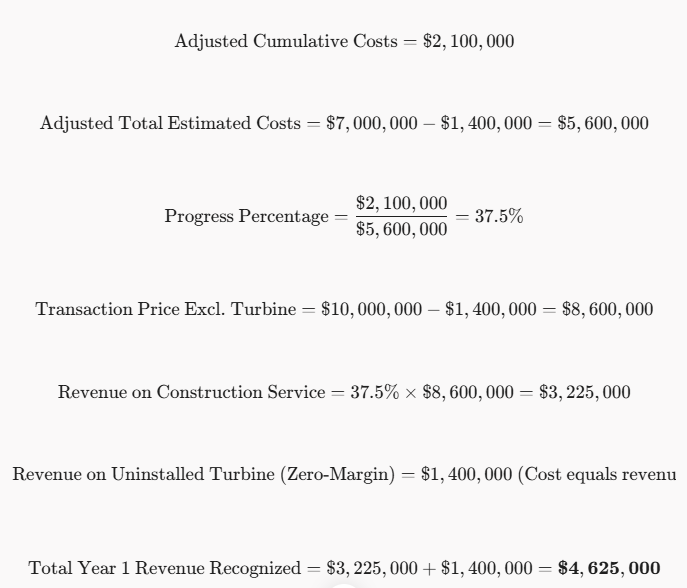
Progress Calculation (Applying IFRS 15.B19):
The turbine meets the criteria for uninstalled materials (significant cost, uninstalled, procured from third party). It must be isolated from the percentage-of-completion calculation.
Year 1 Balance Sheet Status:
- Cumulative Revenue Recognized: $4,625,000
- Cumulative Amount Invoiced: $4,000,000
- Net Contract Asset: $4,625,000 – $4,000,000 = $625,000.
Plaintext
JOURNAL ENTRIES (GLOBAL EPC CONTRACTOR G - YEAR 1):

1. To record direct operational costs and turbine purchase:
Dr. Construction Work-in-Progress (P&L Cost)   $3,500,000
    Cr. Cash / Accounts Payable                             $3,500,000
(To record actual construction and material costs incurred)

2. To record customer billings and cash collection:
Dr. Cash                                       $4,000,000
    Cr. Billings on Contracts (Contra-Asset)                $4,000,000
(To record progress billings issued to customer)

3. To record revenue recognized over time under IFRS 15:
Dr. Contract Asset (Cumulative Revenue Rights) $4,625,000
    Cr. Revenue (IFRS 15 - Over Time)                       $4,625,000
(To record revenue based on adjusted input progress plus uninstalled turbine)

4. Balance Sheet Presentation Reclassification:
Dr. Billings on Contracts                      $4,000,000
    Cr. Contract Asset                                      $4,000,000
(To net billings against contract asset, leaving a net Contract Asset of $625,000)
Case Study 2: Point-in-Time Industrial Equipment Sale with Testing Clause
- Scenario: Heavy Equip Ltd delivers a laser-cutting tool to Manufacturer D on 15 November 2026 for $500,000 cash (Cost of sales: $320,000).
- Contract Terms: The contract stipulates that D has 45 days to run a calibration stress test. If the tool fails to maintain precision tolerances, D can reject the equipment for a full refund.
- Conformity Analysis: Heavy Equip Ltd has never manufactured this specific laser tool tolerance before; historical factory testing has shown an 18% calibration failure rate during on-site commissioning.
- Control Evaluation (IFRS 15.B85): Because the entity cannot objectively determine conformity prior to on-site testing, customer acceptance is substantive. Control does not transfer upon physical delivery on 15 November[cite: 3].
- Resolution: On 28 December 2026, Manufacturer D signs the formal acceptance certificate confirming successful commissioning.
JOURNAL ENTRIES:

1. Upon Delivery (15 November 2026) - No Revenue Recognized:
Dr. Cash                                         $500,000
    Cr. Contract Liability (Customer Advance)                 $500,000
(To record cash received; revenue deferred pending customer acceptance)

Dr. Inventory on Consignment / Customer Site     $320,000
    Cr. Finished Goods Inventory                              $320,000
(To reclassify inventory physically transferred but not derecognized)

2. Upon Formal Customer Acceptance (28 December 2026):
Dr. Contract Liability                           $500,000
    Cr. Revenue (Point-in-Time Recognition)                   $500,000
(To recognize revenue upon satisfaction of customer acceptance criteria)

Dr. Cost of Goods Sold                           $320,000
    Cr. Inventory on Consignment / Customer Site              $320,000
(To derecognize inventory and record cost of sales)
7. Critical Audit Pitfalls in Step 5 Implementation
┌────────────────────────────────────────────────────────────────────────┐
│                   STEP 5 COMMON AUDIT ADJUSTMENT RISKS                 │
├──────────────────────┬─────────────────────────────────────────────────┤
│ Audit Pitfall        │ Technical Violation & Reporting Consequence     │
├──────────────────────┼─────────────────────────────────────────────────┤
│ 1. Using Invoicing   │ • Equating billing schedules directly to        │
│    Schedules as      │   progress without meeting the B16 right to     │
│    Output Measures   │   invoice criteria. Results in front-loaded     │
│                      │   unsupported revenue recognition.              │
├──────────────────────┼─────────────────────────────────────────────────┤
│ 2. Distorted Input   │ • Failing to isolate uninstalled materials      │
│    Calculations with │   under paragraph B19[cite: 3]. Artificially   │
│    Procured Goods    │   accelerates margin recognition before         │
│                      │   installation services occur[cite: 3].        │
├──────────────────────┼─────────────────────────────────────────────────┤
│ 3. Flawed Enforceable│ • Recognizing revenue over time under           │
│    Payment Rights    │   Criterion 35(c) when the contract permits     │
│                      │   customer termination without paying a cost    │
│                      │   plus reasonable profit margin[cite: 2, 5].   │
├──────────────────────┼─────────────────────────────────────────────────┤
│ 4. Treating Material │ • Recognizing equipment revenue at factory      │
│    Acceptance as a   │   shipping when contract clauses give the buyer │
│    Formality         │   unilateral subjective rejection rights        │
│                      │   [cite: 3].                                    │
└──────────────────────┴─────────────────────────────────────────────────┘
8. Mandatory Financial Statement Disclosures (IFRS 15.123–128)
Entities must disclose quantitative and qualitative information regarding Step 5:
- [x] Timing of Satisfaction: Disclose when the entity typically satisfies its performance obligations (upon delivery, upon shipment, as services are rendered).
- [x] Methods Used for Over-Time Obligations: Disclose the methods used to recognize revenue (e.g., input methods based on costs incurred or output methods based on surveys of work performed) and why those methods provide a faithful depiction of progress.
- [x] Significant Judgments in Applying the Standard: Disclose the qualitative assessments made in evaluating whether an asset has an alternative use and whether enforceable payment rights exist under Criterion 35(c).
- [x] Disaggregation of Revenue: Disaggregate revenue recognized from contracts with customers into categories that depict how the nature, amount, timing, and uncertainty of revenue are affected by economic factors (e.g., major product lines, geographical markets, and timing of transfer—over time vs. point in time).
9. Advanced Frequently Asked Questions (FAQs)
Can an entity switch between an input method and an output method during the contract lifecycle?
No. Paragraph 40 mandates that an entity must apply a single method of measuring progress consistently for each performance obligation and across similar contracts and circumstances. A change in method is permitted only as a change in accounting estimate under IAS 8 if the new method more faithfully depicts the transfer of control.
How does standard commercial shipping terminology (FOB Shipping Point vs. FOB Destination) affect Step 5?
International Commercial Terms (Incoterms) like FOB Destination or Ex-Works provide strong legal evidence regarding physical possession, legal title, and risk transfer under paragraph 38. However, under IFRS 15, Incoterms are not determinative on their own; if a seller retains significant operational responsibilities or transit damage replacement obligations, control may not transfer until delivery to the customer’s facility.
If a contract is terminated for customer default, does the right to keep damages qualify as revenue?
If a contract is terminated before performance obligations are satisfied, any non-refundable consideration retained or legal damages awarded are recognized as revenue only if the criteria in IFRS 15.15 are met (the contract has been terminated and consideration received is non-refundable, with no remaining obligations to transfer goods).