IFRS 15 Revenue from Contracts with Customers: Key Changes, Scope Mechanics, and Practical Implementation Guide
1. Executive Summary: The Structural Overhaul of Revenue Accounting
Revenue is arguably the most vital performance metric analyzed by capital markets, equity research analysts, and regulatory bodies. Prior to the issuance of IFRS 15 Revenue from Contracts with Customers, the legacy accounting framework under International Financial Reporting Standards (IFRS) was fragmented across multiple transaction-specific standards and interpretations:
- IAS 18 Revenue (covering sale of goods, rendering of services, interest, royalties, and dividends)
- IAS 11 Construction Contracts
- IFRIC 13 Customer Loyalty Programmes
- IFRIC 15 Agreements for the Construction of Real Estate
- IFRIC 18 Transfers of Assets from Customers
- SIC-31 Revenue – Barter Transactions Involving Advertising Services
These legacy standards suffered from notable inconsistencies, provided limited guidance on complex transactions (such as bundled multi-element arrangements, variable pricing, and software licensing), and relied heavily on bright-line rules under US GAAP or broad, high-level concepts under IFRS.
┌────────────────────────────────────────────────────────────────────────┐
│                   THE REVENUE RECOGNITION EVOLUTION                    │
├──────────────────────────┬─────────────────────────────────────────────┤
│ Legacy Framework         │ IFRS 15 / ASC Topic 606                     │
│ (IAS 18 / IAS 11)        │ (Current Standard)                          │
├──────────────────────────┼─────────────────────────────────────────────┤
│ Fragmented Guidance      │ Single, Comprehensive Framework             │
│ (Multiple standards and  │ (Universal five-step model applied across   │
│ industry interpretations)│ all industries and contracts)│
├──────────────────────────┼─────────────────────────────────────────────┤
│ Risks and Rewards Model  │ Control-Based Model                         │
│ (Focus on legal title &  │ (Focus on customer's ability to direct use  │
│ physical risk transfer)  │ and obtain substantially all benefits)│
├──────────────────────────┼─────────────────────────────────────────────┤
│ Limited Separation Rules │ Distinct Component Accounting               │
│ (Inconsistent bundling & │ (Strict separation of distinct performance  │
│ allocation methods)      │ obligations based on standalone prices)│
├──────────────────────────┼─────────────────────────────────────────────┤
│ Minimal Disclosures      │ Cohesive, Granular Disclosures              │
│ (Sparse footnote data    │ (Disaggregation of revenue, contract balances,│
│ on contract pipelines)   │ judgments, and capitalized costs)│
└──────────────────────────┴─────────────────────────────────────────────┘
Developed as a joint initiative between the International Accounting Standards Board (IASB) and the Financial Accounting Standards Board (FASB) to converge IFRS and US GAAP (ASC Topic 606), IFRS 15 establishes a single, comprehensive principles-based framework effective for annual periods beginning on or after 1 January 2018.
The Core Principle
Paragraph 2 and IN7 establish the core principle of IFRS 15:
An entity recognizes revenue to depict the transfer of promised goods or services to customers in an amount that reflects the consideration to which the entity expects to be entitled in exchange for those goods or services.
2. Key Changes: How IFRS 15 Redefined Revenue Recognition
2.1. From “Risks and Rewards” to the “Transfer of Control”
Under IAS 18, revenue recognition centered on whether the seller had transferred the significant risks and rewards of ownership to the buyer. Under IFRS 15, the transfer of risks and rewards is no longer the sole determinant; it is merely one of several indicators evaluated within a wider control model.
- Definition of Control: Under IFRS 15, control of an asset is the ability to direct the use of, and obtain substantially all of the remaining benefits from, that asset. It also includes the active ability to prevent other entities from directing the use of, and obtaining benefits from, the asset.
- Impact: In long-term manufacturing, construction, and asset development contracts, revenue recognition profiles have shifted significantly between point-in-time and over-time recognition.
2.2. Rigid Unbundling of Multi-Element Arrangements
Entities providing bundled packages (e.g., telecom operators selling mobile handsets bundled with network connectivity, or software vendors providing licenses with maintenance and implementation) can no longer account for the transaction as an undifferentiated whole. IFRS 15 mandates identifying every distinct good or service as a separate performance obligation and allocating transaction prices based on relative standalone selling prices, often accelerating or deferring revenue recognition relative to cash billing milestones.
2.3. Stringent Guidance on Variable Consideration & The “Constraint”
Under legacy standards, contingent fees or variable revenue were recognized when they were “probable” of being received. IFRS 15 introduces a strict two-stage requirement:
- Estimate variable consideration using either the expected value (probability-weighted amount) or the most likely amount method.
- Apply the variable consideration constraint: Variable amounts are included in the transaction price only to the extent that it is highly probable that a significant reversal in the cumulative revenue recognized will not occur when the underlying uncertainty is resolved.
3. Scope of IFRS 15: Inclusions, Exclusions, and Boundary Cases
Paragraph 5 sets the operational scope of IFRS 15: it applies to all contracts with customers, subject to explicit exclusions.
                 IFRS 15 APPLICABILITY & SCOPE ASSESSMENT
                 ════════════════════════════════════════
             Is the counterparty a CUSTOMER contracting for an
             output of the entity's ordinary business activities?
                                      │
                       ┌──────────────┴──────────────┐
                      YES                            NO
                       │                             │
                       ▼                             ▼
           Evaluate Scope Exclusions            OUT OF SCOPE
         (IFRS 16, IFRS 17, IFRS 9, etc.)     (e.g., Collaborators,
                       │                       Investors, Partners)
        ┌──────────────┴──────────────┐
   Fully / Partially             Fully Outside
    Within Scope                  Specific Scope
        │                             │
        ▼                             ▼
   Apply IFRS 15              Apply Dedicated Standard
  (Allocate price)           (IFRS 16, IFRS 9, IFRS 17)
3.1. Defining a “Customer” vs. a “Collaborative Partner”
Under paragraph 6, IFRS 15 applies only if the counterparty to the contract is a customer:
- A Customer is a party that has contracted with an entity to obtain goods or services that are an output of the entity’s ordinary activities in exchange for consideration.
- Collaborative Arrangements / Joint Ventures: Contracts where the counterparty shares in the risks and benefits of an activity or process (e.g., joint biotechnology development of a drug candidate or co-developing commercial property) fall outside the scope of IFRS 15 because the counterparty is a partner or collaborator, not a customer. However, if an arrangement contains distinct customer elements (e.g., one partner provides contract research services for a guaranteed fee), that specific component falls within IFRS 15.
3.2. Mandatory Scope Exclusions (IFRS 15.5)
The following contracts and transactions are formally excluded from IFRS 15:
- Lease Contracts: Falling within the scope of IFRS 16 Leases. PDF+ 1
- Insurance Contracts: Falling within the scope of IFRS 17 Insurance Contracts. (Exception: An entity may elect to apply IFRS 15 to insurance contracts whose primary purpose is the provision of services for a fixed fee, under IFRS 17.8). PDF+ 2
- Financial Instruments & Contractual Rights/Obligations: Governed by IFRS 9 Financial Instruments, IFRS 10 Consolidated Financial Statements, IFRS 11 Joint Arrangements, IAS 27 Separate Financial Statements, and IAS 28 Investments in Associates and Joint Ventures. PDF+ 1
- Guarantees: Non-insurance financial guarantees within the scope of IFRS 9 (distinct from standard product or service warranties). PDF
- Non-Monetary Exchanges in the Same Line of Business: Barter transactions between entities in the same industry to facilitate sales to customers (e.g., two oil companies exchanging inventory in different geographic hubs to fulfill customer demand on a timely basis) are excluded from IFRS 15 to prevent artificial revenue gross-ups on what is effectively a single economic supply.
Technical Nuance on Barter Transactions: Barter transactions are within the scope of IFRS 15 if the entities are not in the same line of business or if the exchange is not intended to facilitate sales to third-party customers (e.g., a manufacturing entity exchanging heavy equipment with an oil refiner for fuel supplies, provided commercial substance exists).
3.3. Partially In-Scope Contracts (Multi-Standard Contracts)
Many commercial arrangements bundle elements governed by different accounting standards. When a contract falls partially within IFRS 15 and partially within other standards, paragraph 7 mandates a clear hierarchy of separation:
┌────────────────────────────────────────────────────────────────────────┐
│             SEPARATION HIERARCHY FOR MULTI-STANDARD CONTRACTS          │
└───────────────────────────────────┬────────────────────────────────────┘
                                    │
    Do other IFRS standards specify how to separate and/or measure       │
                 one or more parts of the contract?                      │
                                    │
                     ┌──────────────┴──────────────┐
                    YES                            NO
                     │                             │
                     ▼                             ▼
       Apply Other Standard First        Apply IFRS 15 Separation Rules
     • Separate and initially measure   • Apply Step 4 (Standalone
       specified components first.        Selling Price allocation) to
     • Exclude that measured amount       the entire bundled contract
       from transaction price.            price.
     • Allocate remainder to IFRS 15
       components.
- Practical Example (Automotive & Leasing): A vehicle manufacturer enters into a three-year agreement to lease a fleet of vehicles to a corporate client, while also bundling fleet administration, annual maintenance, and roadside assistance.
- The lease component must be separated and measured first under IFRS 16 Leases. PDF
- The remaining consideration is allocated to the non-lease service components (maintenance and roadside assistance) and accounted for under IFRS 15.
- Banking & Credit Card Fees: The IFRS Interpretations Committee (IFRIC) and Transition Resource Group (TRG) addressed credit card agreements bundling payment facilities with customer loyalty reward points and airport lounge access. Card-issuing banks must first isolate components governed by IFRS 9 (interest, late payment charges), with the ancillary non-credit service obligations falling under IFRS 15.
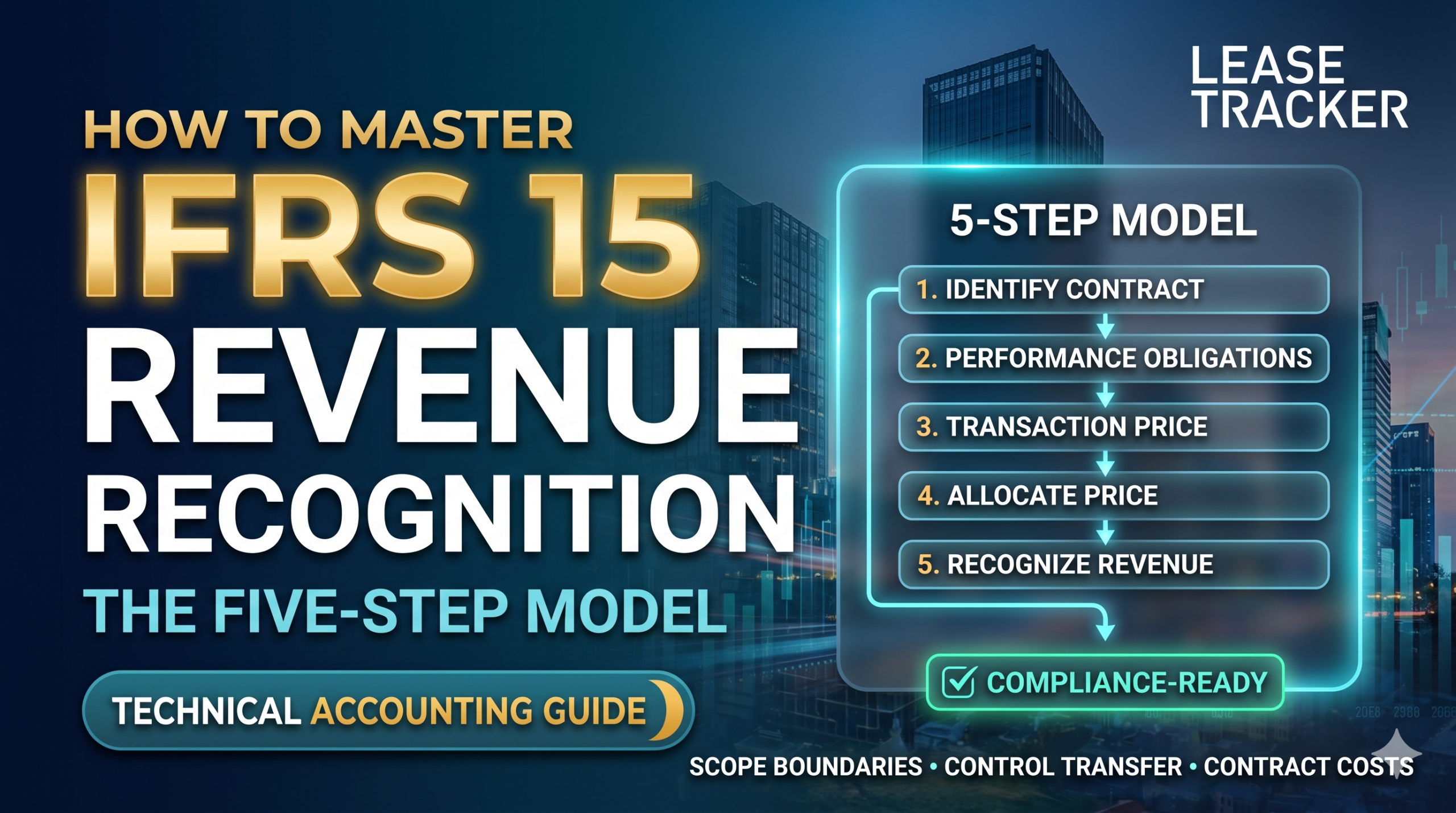
4. The Five-Step Revenue Recognition Framework
The five-step model is the operational core of IFRS 15, establishing a systematic workflow for every revenue contract.
┌─────────────────────────────────────────────────────────────────────────┐
│                    THE IFRS 15 FIVE-STEP FRAMEWORK                      │
│                                                                         │
│   [Step 1] Identify the Contract with a Customer (IFRS 15.9)            │
│      └── Valid, approved agreement creating enforceable rights/debt   │
│                                                                         │
│   [Step 2] Identify Separate Performance Obligations (IFRS 15.22)       │
│      └── Isolate distinct goods or services promised to customer       │
│                                                                         │
│   [Step 3] Determine the Transaction Price (IFRS 15.47)                 │
│      └── Fixed/variable consideration, financing, non-cash, concessions│
│                                                                         │
│   [Step 4] Allocate the Transaction Price (IFRS 15.73)                  │
│      └── Relative Standalone Selling Price (SSP) allocation           │
│                                                                         │
│   [Step 5] Recognize Revenue as Obligations are Satisfied (IFRS 15.31)  │
│      └── Over time (input/output methods) vs. Point in time (control) │
└─────────────────────────────────────────────────────────────────────────┘
Step 1: Identify the Contract with a Customer (IFRS 15.9)
A contract exists for accounting purposes only when all five criteria under paragraph 9 are met:
- Approval & Commitment: Parties have approved the contract (in writing, orally, or per customary business practices) and are committed to performing their obligations.
- Identifiable Rights: Each party’s rights regarding the goods or services to be transferred are identifiable.
- Identifiable Payment Terms: Payment terms are identifiable.
- Commercial Substance: The risk, timing, or amount of the entity’s future cash flows is expected to change as a result of the contract.
- Collectibility is Probable: It is probable that the entity will collect the consideration entitled to in exchange for goods/services. Only the customer’s ability and intention to pay are evaluated here.
Wholly Unperformed Contracts (IFRS 15.12): A contract does not exist under IFRS 15 if each party has the unilateral enforceable right to terminate a wholly unperformed contract without compensating the other party. A contract is wholly unperformed if the vendor has transferred no goods/services and has received (and is entitled to receive) no consideration.
Step 2: Identify Performance Obligations (IFRS 15.22)
A performance obligation is an explicit or implicit promise to transfer a distinct good or service (or bundle of goods/services). Under paragraph 27, a good or service is distinct if both criteria are met:
- Capable of being distinct: The customer can benefit from the good or service on its own or together with readily available resources.
- Distinct within the context of the contract: The promise to transfer the good or service is separately identifiable from other promises in the contract (i.e., the vendor is not providing a significant integration service, significant customization, or highly interdependent goods).
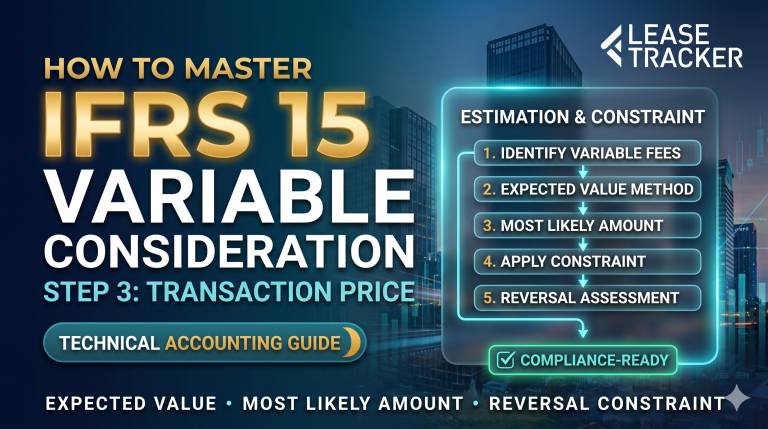
Step 3: Determine the Transaction Price (IFRS 15.47)
The transaction price is the amount of consideration an entity expects to be entitled to, excluding amounts collected on behalf of third parties (e.g., sales taxes)[cite: 14, 16]. Preparers must adjust the transaction price for four critical elements:
- Variable Consideration: Discounts, rebates, price concessions, penalties, and performance bonuses must be estimated using the expected value or most likely amount method, subject to the constraint (IFRS 15.56).
- Significant Financing Component: If the timing of payments agreed by the parties provides the customer or the entity with a significant benefit of financing the transfer of goods or services, the transaction price must be adjusted for the time value of money.
- Non-Cash Consideration: Measured at fair value at contract inception.
- Consideration Payable to a Customer: Cash payments, credits, or vouchers paid to a customer are treated as a reduction of the transaction price (and thus revenue) unless paid in exchange for a distinct good or service.
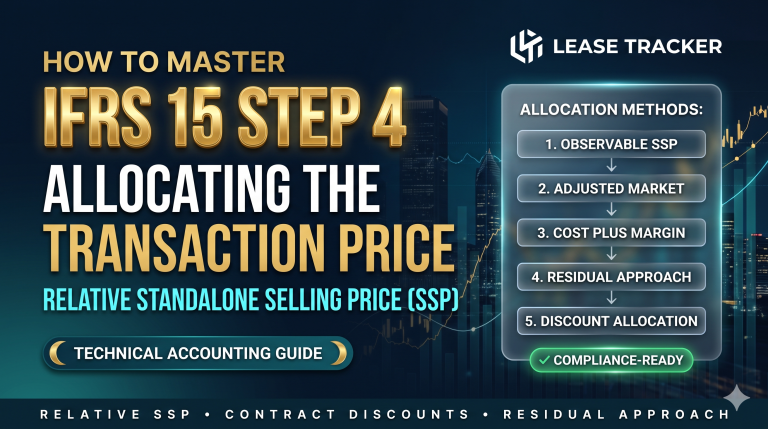
Step 4: Allocate the Transaction Price to Performance Obligations (IFRS 15.73)
The transaction price is allocated to each separate performance obligation in proportion to its relative Standalone Selling Price (SSP) at contract inception. Subsequent changes in SSP cannot be reallocated. If an SSP is not directly observable on the market, the vendor must estimate it using acceptable methods:
- Adjusted Market Assessment Approach
- Expected Cost Plus a Margin Approach
- Residual Approach (permitted only in narrow circumstances where selling prices are highly variable or uncertain)
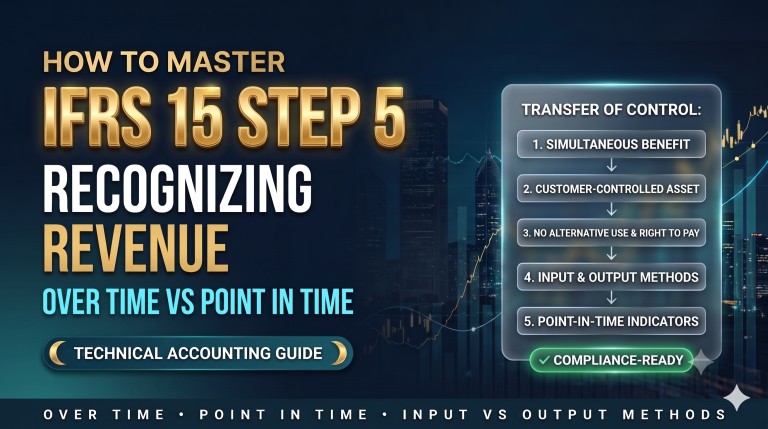
Step 5: Recognize Revenue as Performance Obligations are Satisfied (IFRS 15.31)
Revenue is recognized when (or as) the entity satisfies a performance obligation by transferring control of a promised good or service.
┌────────────────────────────────────────────────────────────────────────┐
│               OVER TIME VS. POINT IN TIME EVALUATION                   │
├────────────────────────────────────────────────────────────────────────┤
│ RECOGNIZE REVENUE OVER TIME (if ANY of 3 criteria in IFRS 15.35 met): │
│ 1. Customer simultaneously receives and consumes benefits as vendor    │
│    performs (e.g., routine cleaning, security services).│
│ 2. Vendor's performance creates or enhances an asset controlled by the │
│    customer (e.g., construction on customer-owned land).    │
│ 3. Vendor's performance creates an asset with NO alternative use AND   │
│    vendor has an enforceable right to payment for performance to date  │
│    (e.g., specialized manufacturing to custom specs).   │
├────────────────────────────────────────────────────────────────────────┤
│ RECOGNIZE AT A POINT IN TIME:                                          │
│ If none of the three over-time criteria are met, control transfers at  │
│ a specific point in time (indicators: physical possession, legal title,│
│ customer acceptance, present right to payment)[cite: 14, 15, 17].     │
└────────────────────────────────────────────────────────────────────────┘
5. Contract Costs: Accounting for Obtaining and Fulfilling Contracts
IFRS 15 introduced formal capitalization criteria for contract costs, codified in IFRS 15.91–104 and ASC 340-40.
┌────────────────────────────────────────────────────────────────────────┐
│                     CONTRACT COST ACCOUNTING MATRIX                    │
├──────────────────────────┬─────────────────────────────────────────────┤
│ Cost Category            │ Accounting Mandate & Treatment              │
├──────────────────────────┼─────────────────────────────────────────────┤
│ Incremental Costs of     │ • Capitalized as an asset if EXPECTED to be │
│ Obtaining a Contract     │   recovered (e.g., direct sales commission) │
│ (IFRS 15.91)             │  [cite: 14, 15]                            │
│                          │ • Costs that would be incurred regardless   │
│                          │   (e.g., legal drafting, travel, bid costs) │
│                          │   must be expensed as incurred.  │
│                          │ • Practical Expedient (IFRS 15.94): Expense │
│                          │   immediately if amortization period ≤ 1 yr │
│                          │  .                               │
├──────────────────────────┼─────────────────────────────────────────────┤
│ Costs to Fulfill         │ • Must first be assessed under other        │
│ a Contract               │   standards (IAS 2, IAS 16, IAS 38)│
│ (IFRS 15.95)             │ • If outside other standards, capitalize IF:│
│                          │   a) Costs relate directly to an identified │
│                          │      contract;                              │
│                          │   b) Costs generate or enhance resources of │
│                          │      the entity that will satisfy future    │
│                          │      obligations; AND                       │
│                          │   c) Costs are expected to be recovered     │
│                          │     .                            │
└──────────────────────────┴─────────────────────────────────────────────┘
Audit Insight on Incremental Costs: The BDO and KPMG implementation reviews emphasize that the threshold for capitalising costs to obtain a contract is strictly incremental—a much higher hurdle than the general “directly attributable” standard under IAS 38. In corporate audits, general administrative overhead, bid preparation expenses, and pre-sales marketing cannot be capitalized; capitalization is virtually restricted to external success commissions.
6. Practical Implementation Challenges Across Key Industries
Corporate experience highlights that IFRS 15 implementation is not a uniform technical exercise; its operational impact varies dramatically across sectors.
┌────────────────────────────────────────────────────────────────────────┐
│                 SECTOR-SPECIFIC IMPLEMENTATION PITFALLS                │
├──────────────────────┬─────────────────────────────────────────────────┤
│ Industry Sector      │ Complex Technical Pitfalls                      │
├──────────────────────┼─────────────────────────────────────────────────┤
│ Telecommunications   │ • High-volume consumer contract bundling        │
│                      │ • Massive contract asset capitalization on      │
│                      │   subsidized hardware                │
│                      │ • Variable breakage and usage concessions[cite: 15, 16] │
├──────────────────────┼─────────────────────────────────────────────────┤
│ Software & SaaS      │ • Distinguishing Right to Access (over time) vs.│
│                      │   Right to Use (point in time) licenses[cite: 14, 15]  │
│                      │ • Identifying distinct post-contract support    │
│                      │   (PCS) and hosting performance obligations│
├──────────────────────┼─────────────────────────────────────────────────┤
│ Construction & Real  │ • Enforceability of payment for performance to  │
│ Estate Development   │   date (determining over-time eligibility) │
│                      │ • Progress measurement via input vs. output     │
│                      │   methods                            │
│                      │ • Unapproved contract modification claims│
└──────────────────────┴─────────────────────────────────────────────────┘
6.1. Telecommunications: Bundled Handsets and Service Plans
Consider a telecom operator offering a high-end smartphone with a 24-month network subscription for a monthly fee of $60, charging $0 upfront for the smartphone.
- Legacy IAS 18: The company recognized $0 hardware revenue on delivery and recognized $60 monthly as service revenue.
- IFRS 15 Impact:
- Handset and network connectivity are two separate performance obligations. HTML
- Transaction price ($60×24=$1,440) must be allocated based on standalone selling prices (e.g., phone standalone price $800; 2-year service standalone price $1,200).
- The phone receives an allocated price of $576, recognized as revenue at a point in time on day one, creating a large Contract Asset on the balance sheet: Dr. Contract Asset $576/Cr. Revenue $576
- Over the 24 months, the monthly cash receipts of $60 are split between service revenue ($36) and recovery of the contract asset ($24).
6.2. Technology & Software: Licensing (Right to Access vs. Right to Use)
IFRS 15.B52 provides specific application guidance on intellectual property (IP) licensing:
- Right to Access (Revenue Over Time): Applies if the contract requires, or the customer reasonably expects, that the entity will undertake activities that significantly affect the intellectual property, exposing the customer to positive or negative effects (e.g., cloud-hosted SaaS platforms, continuously updated dynamic anti-virus software).
- Right to Use (Revenue at a Point in Time): Applies if the IP has significant standalone functionality and the customer directs the use of the IP as it exists at the grant date (e.g., perpetual on-premise software licenses). Revenue must be recognized in full when the license key is delivered and operational.
6.3. Contract Modifications: The Three Accounting Paths (IFRS 15.20–21)
When parties approve a change in the scope or price of an existing contract, the accounting treatment depends on whether additional goods/services are distinct and priced at market rates:
┌────────────────────────────────────────────────────────────────────────┐
│                 CONTRACT MODIFICATION DECISION FRAMEWORK               │
└───────────────────────────────────┬────────────────────────────────────┘
                                    │
    Are the additional goods/services distinct AND priced at             │
                   standalone selling prices (SSP)?                      │
                                    │
                     ┌──────────────┴──────────────┐
                    YES                            NO
                     │                             │
                     ▼                             ▼
         SEPARATE CONTRACT (IFRS 15.20)    Are remaining goods/services
         • Accounted for prospectively       distinct from transferred goods?
         • Original contract unaffected                    │
                                            ┌──────────────┴──────────────┐
                                           YES                            NO
                                            │                             │
                                            ▼                             ▼
                                   TERMINATION & NEW              CUMULATIVE CATCH-UP
                                   CONTRACT (PROSPECTIVE)         (IFRS 15.21(b))
                                   (IFRS 15.21(a))                • Measure overall
                                   • Reallocate remaining           performance to date
                                     consideration to               and adjust                                                                               cumulative
                                     remaining distinct             revenue in current
                                     obligations.                    period.
7. Financial Statement Presentation & Disclosure Mechanics
7.1. Net Contract Presentation (TRG Agenda Paper 7)
Paragraph 105 mandates that an entity present a contract in the statement of financial position as a Contract Asset or a Contract Liability, depending on the relationship between the entity’s performance and the customer’s payment:
- Contract Asset: An entity’s right to consideration in exchange for goods or services transferred to the customer when that right is conditioned on something other than the passage of time (e.g., future performance milestones).
- Receivable: An unconditional right to consideration, where only the passage of time is required before payment is due.
- Contract Liability: An obligation to transfer goods or services for which the vendor has received consideration (or an amount is due) from the customer (deferred revenue).
TRG Decision: Under TRG Agenda Paper 7, presentation must be evaluated at the contract level, not at the individual performance obligation level. An entity cannot present both a contract asset and a contract liability for the same legal contract; balances must be netted into a single net contract position.
7.2. Comprehensive Disclosure Mandates (IFRS 15.110–129)
IFRS 15 established an unprecedented level of mandatory disclosures, intended to provide transparency regarding the nature, amount, timing, and uncertainty of revenue and cash flows:
- [x] Disaggregation of Revenue: Disclose revenue categorized by primary geographic market, major product lines, contract duration (short-term vs. long-term), timing of transfer (point-in-time vs. over time), and sales channels.
- [x] Contract Balances: Disclose opening and closing balances of contract assets, contract liabilities, and trade receivables, explaining significant variances.
- [x] Performance Obligations: Qualitative disclosures detailing typical timing of satisfaction, payment terms, refund obligations, return privileges, and warranty types.
- [x] Significant Judgments: Detailed explanation of methods used to estimate variable consideration, evaluate constraints, identify standalone selling prices, and determine over-time completion progress.
- [x] Capitalized Contract Costs: Disclose the closing balances of assets recognized from costs to obtain and fulfill contracts, along with periodic amortization and impairment charges.
8. Transition Approaches: Full vs. Modified Retrospective
When adopting or auditing IFRS 15, entities select between two transition methods specified in Appendix C:
| Feature | Full Retrospective Approach (IFRS 15.C3(a)) | Modified Retrospective Approach (IFRS 15.C3(b)) |
|---|---|---|
| Comparative Periods | Prior comparative periods are restated in full as if IFRS 15 had always applied. HTML+ 1 | Prior comparative figures are not restated; reported under legacy standards. HTML+ 1 |
| Cumulative Catch-Up | Recognized within opening equity of the earliest comparative period presented[cite: 15]. | Cumulative effect recognized as an adjustment to opening retained earnings at the date of initial application[cite: 15]. |
| Data Requirements | Extremely burdensome; requires historic contract data across all comparative periods[cite: 15]. | Significantly less burdensome; applied only to active, uncompleted contracts at initial application. HTML+ 1 |
| Comparability | High comparability across historical financial statements[cite: 15]. | Reduced comparability; requires footnote reconciliations of line items to legacy GAAP[cite: 15]. |
The vast majority of corporate reporting entities selected the modified retrospective approach to manage implementation costs and avoid reconstructing completed multi-year legacy contracts.
HTML+ 1
9. Frequently Asked Questions (FAQ)
What is the difference between a Contract Asset and a Trade Receivable under IFRS 15?
A Trade Receivable represents an unconditional legal right to payment where only the passage of time is required before cash is due. A Contract Asset represents a conditional right to consideration because the entity has delivered some goods or services, but must satisfy another performance obligation (e.g., completing an integration milestone) before it has an unconditional right to invoice the customer.
How are sales warranties accounted for under IFRS 15?
Warranties are classified into two categories:
- Assurance-Type Warranties: Promise that the product complies with agreed specifications. Governed by IAS 37 Provisions, Contingent Liabilities and Contingent Assets as an operational cost provision.
- Service-Type Warranties: Provide an additional, distinct service beyond basic compliance (e.g., extended protection). Accounted for as a separate performance obligation under IFRS 15, requiring an allocation of the transaction price and revenue recognition over the service duration.
Can an entity capitalize internal research and development costs under IFRS 15?
No. IFRS 15.95 explicitly requires costs to fulfill a contract to be evaluated under other applicable standards first. Internal R&D must be evaluated under IAS 38 Intangible Assets.. If the costs fail the development asset recognition criteria of IAS 38, they must be expensed as incurred and cannot be capitalized under IFRS 15.